Signs Your Water Heater Is Going Out? Here's What to Do
Kevin Allen
Co-Founder & Service Lead

Spot the signs your water heater is going out early and learn when to repair or replace before costly breakdowns strike.
Is Your Water Heater Trying to Tell You Something?
The signs your water heater is going out are often easy to miss — until you're standing in a cold shower or mopping up a flooded utility room. Here's a quick look at the most common warning signs so you know what to watch for:
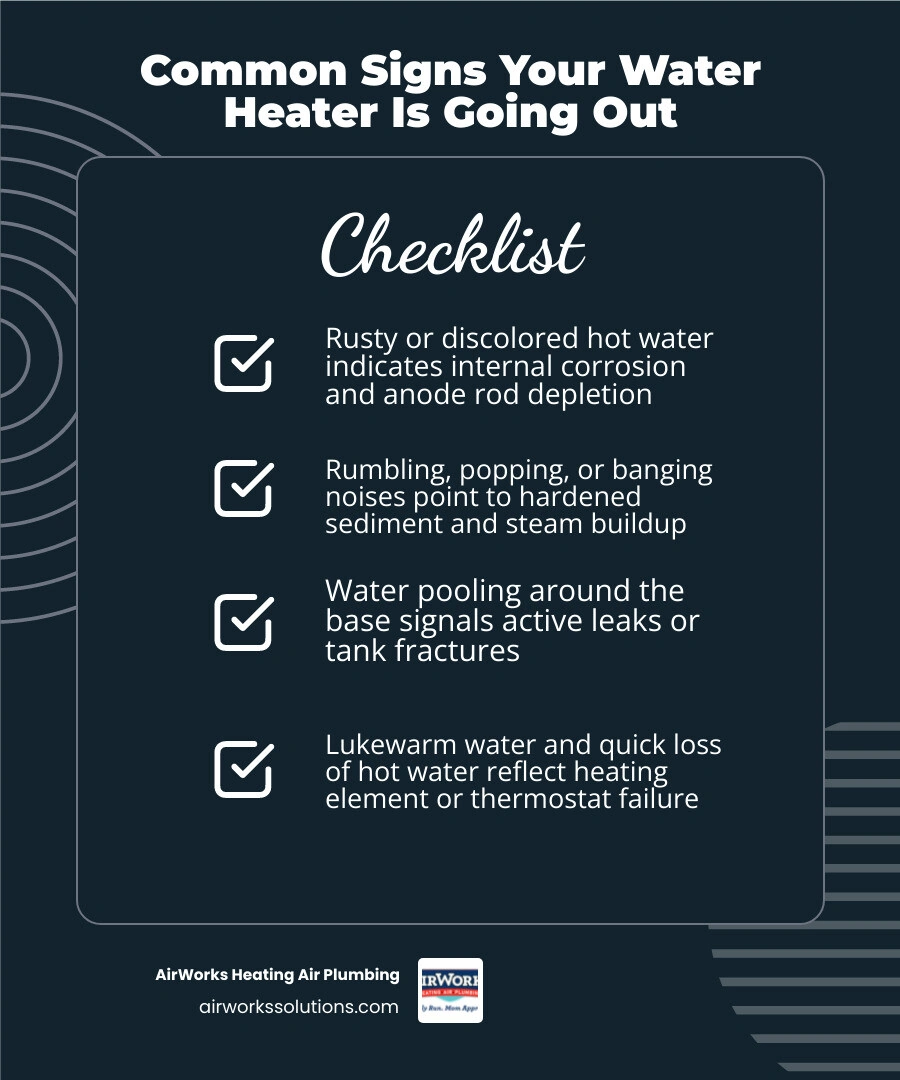
Common Signs Your Water Heater Is Going Out:
- Rusty, discolored, or cloudy hot water
- Rumbling, popping, or banging noises from the tank
- Water pooling around the base of the unit
- Lukewarm water or inconsistent temperatures
- Running out of hot water faster than usual
- Unexplained increases in your energy bills
- The unit is 10 years old or older
Your water heater is one of the few home appliances that works every single day of the year. Unlike your AC, which runs hard in summer, or your heating system, which carries you through winter, your water heater never really gets a break. That constant demand adds up — and eventually, wear and tear catches up with every unit.
The good news is that most water heaters don't fail without warning. They send signals for weeks or even months before the situation becomes an emergency. Knowing what those signals look like can be the difference between a planned replacement on your terms and a four-figure water damage disaster on the worst possible day.
I’m Kevin Allen, co-founder of AirWorks, and our service and installation crews report to me. Read on for a straightforward breakdown of what to look for and exactly what to do about it.
Basic signs your water heater is going out glossary:
- how long does a water heater last
- how long do tankless water heaters last
- how to extend the life of your water heater
Red Flag Signs Your Water Heater Is Going Out
When a water heater begins to fail, it rarely does so in complete silence. Instead, it drops hints. If you know how to read these signs, you can avoid waking up to a flooded garage or basement.
Many common water heater issues stem from sediment buildup and mineral deposits. As hard water is heated, minerals like calcium and magnesium precipitate out of the water and settle at the bottom of the tank. Over time, this creates a thick layer of scale that insulates the water from the heating element. The burner has to work twice as hard to heat the water, which overheats the tank bottom, weakens the steel, and eventually leads to a complete system failure.
Ignoring these warning signs doesn't just mean dealing with cold showers; it also exposes your home to major safety hazards and severe water damage risks. According to industry data, the average water damage claim from a failed water heater is around $9,000, and insurance companies frequently deny these claims if they find the homeowner neglected basic maintenance.
Here are the specific red flags you need to watch out for.
Rusty or Discolored Water: Signs Your Water Heater Is Going Out
If you turn on your hot water tap and see a reddish, brown, or rusty tint, your system is sending an urgent distress signal. Inside every traditional tank water heater is a sacrificial anode rod. This rod is made of highly active metals (like magnesium or aluminum) designed to attract corrosive elements in the water. The rod rusts so your steel tank doesn't have to.
According to the U.S. Department of Energy (2024), these rods last roughly 3 to 5 years depending on your local water chemistry. Once the anode rod is fully depleted, those corrosive minerals turn their attention to the steel walls of your tank. This leads to internal tank corrosion, which flakes off into your hot water supply.
To determine if the rust is coming from your water heater or your main plumbing lines, try running only cold water into a clear glass. If the cold water runs clear but the hot water is discolored, the culprit is almost certainly your water heater. At this point, the tank's internal glass lining is likely cracking, exposing the steel underneath to rust.
If you live in Ventura County, our hard water can accelerate this process. If you catch this early, a technician may be able to save the unit by replacing the anode rod and flushing the system. For professional diagnostics, check out our Water Heater Repair Thousand Oaks Guide or schedule an inspection with our team for Water Heater Repair Agoura Hills.
Strange Noises: Auditory Signs Your Water Heater Is Going Out
Have you started hearing strange rumbling, popping, or banging noises coming from your utility closet? Many homeowners describe these sounds as sounding like popcorn popping or heavy rocks tumbling inside the tank.
This is a classic symptom of hardened sediment. As mineral scale builds up at the bottom of the tank, it traps small pockets of water underneath it. When the burner fires up, that trapped water is heated to boiling temperatures, turning into steam. The steam bubbles must violently force their way up through the heavy layer of sediment to escape, which creates the loud popping and rumbling sounds you hear.
If left unaddressed, this constant overheating can cause the tank bottom to warp, fatigue, and crack. If your water heater is already making these noises, a standard flush may not be enough because the sediment has likely hardened into a concrete-like crust. If you hear these sounds in the Sacramento area, our specialists in Water Heater Repair Elk Grove can inspect the unit to see if the tank is still salvageable.
Water Pooling Around the Base
Finding standing water or dampness around the base of your water heater is an absolute emergency. While some leaks can be traced back to loose pipe fittings or a dripping temperature and pressure (T&P) relief valve, pooling water often points to a fractured internal tank.
As the steel tank expands and contracts during daily heating cycles, structural stress accumulates. Over years of thermal expansion, combined with internal corrosion or sediment overheating, microscopic cracks develop in the metal. Once the tank body itself begins to leak, it cannot be repaired. The only solution is a full system replacement.
If you spot water pooling:
- Shut off the power supply: Turn off the circuit breaker for an electric heater or turn the gas valve to "Off" for a gas unit.
- Turn off the water: Locate the cold water shutoff valve above the heater and turn it clockwise to stop incoming water.
- Call a professional: Do not wait for the leak to worsen. A compromised tank can rupture completely, dumping 40 to 80 gallons of water into your home in a matter of minutes.
For homeowners utilizing modern on-demand systems, tankless units can also develop leaks around their heat exchangers due to scale buildup. If you suspect an issue, contact us for Tankless Water Heater Repair Thousand Oaks.
Inconsistent Temperatures and Lukewarm Water
Are your showers starting warm but quickly turning lukewarm? Or perhaps the water never reaches a comfortable temperature at all? Inconsistent temperatures usually point to a mechanical or electrical failure.
In electric water heaters, the culprit is often a failed heating element or a malfunctioning thermostat. Most electric tanks use two elements: an upper and a lower one. The lower element does roughly 70% of the work. If it burns out—often because it is buried in sediment—the upper element has to carry the entire load, resulting in lukewarm water that doesn't last.
For gas water heaters, temperature issues might stem from a faulty thermocouple, a failing gas valve, or a broken dip tube. The dip tube is a plastic pipe that directs incoming cold water straight to the bottom of the tank to be heated. If the dip tube cracks or disintegrates, cold water mixes directly with the hot water at the top of the tank, delivering a lukewarm blend to your taps.
Running Out of Hot Water Quickly
If your household used to enjoy back-to-back showers without issue, but now the hot water runs out after just five minutes, you are dealing with severely reduced tank capacity.
This is another direct consequence of heavy sediment accumulation. Over several years, mineral buildup can take up a significant portion of the tank's interior volume. If you have a 50-gallon tank, but 15 gallons of that space is occupied by hardened mineral deposits, you only have 35 gallons of actual hot water capacity.
As your household hot water demand remains the same, your system simply cannot keep up. A professional flush can sometimes restore capacity, but if the sediment is too thick, the tank will need to be replaced.
How Age Factors Into Water Heater Replacement Decisions
Even if your water heater isn't currently leaking or making loud noises, its age is the single strongest predictor of a sudden failure. Understanding how long these systems are built to last helps you plan a proactive replacement rather than reacting to a middle-of-the-night plumbing disaster.
Tank vs. Tankless Lifespans
The lifespan of your water heater depends heavily on the technology it uses and how well it has been maintained:
- Traditional Tank Water Heaters: Most conventional tank systems last between 8 and 12 years. The U.S. Department of Energy (2024) notes that after year 12, the failure rate for tank-style heaters climbs sharply. Without regular flushing, hard water can shorten this lifespan to just 6 to 10 years.
- Tankless Water Heaters: On-demand tankless systems last considerably longer, typically reaching 20 years or more with proper maintenance. Because they do not store standing water, they are far less prone to internal rust. However, they still require regular descaling to protect their heat exchangers from mineral blockages.
If you are trying to decide which system is right for your home, explore our guide on Is a Tankless Water Heater Worth It or learn about the process of Switching from Tank to Tankless Water Heater.
How to Check Your Water Heater's Age
You don't have to guess how old your water heater is. Every manufacturer includes the production date on the rating plate label, though it is usually encoded within the serial number.
To decode your water heater's age:
- Locate the manufacturer's label on the side of the tank.
- Find the serial number (not the model number).
- Look at the first letter and the first two numbers:
- The Letter: Represents the month of manufacture (A = January, B = February, C = March, and so on, skipping "I").
- The First Two Numbers: Represent the year of manufacture.
For example, a serial number starting with D20 indicates the unit was manufactured in April 2020. If your serial number starts with F14, it was built in June 2014. Given that the current year is 2026, a 2014 unit is now 12 years old and well past its prime. If your system is over 10 years old, it is highly recommended to begin planning for a replacement before an emergency occurs.
Repair vs. Replace: Making the Right Decision
When your water heater acts up, you have to decide whether to pay for a repair or invest in a new unit. To help you make the right call, we recommend using the 50% Rule: if the repair cost exceeds 50% of the cost of a new water heater, or if the unit is more than 8 to 10 years old, replacement is generally the smarter financial decision.
| Factor | Consider Repair | Consider Replacement |
|---|---|---|
| System Age | Under 8 years old | Over 10 years old |
| Leak Location | Minor leak from a valve or fitting | Active leak from the tank body itself |
| Water Quality | Clear water | Rusty, metallic-smelling hot water |
| Repair Cost | Less than 50% of replacement cost | More than 50% of replacement cost |
| Energy Bills | Stable or minor fluctuations | Climbing rapidly due to poor efficiency |
When to Choose a High-Efficiency Upgrade
If you decide to replace your water heater, upgrading to a high-efficiency model is an excellent way to lower your monthly utility costs. Water heating is a major household expense, accounting for roughly 14% to 18% of the average home's energy bills.
Upgrading to an ENERGY STAR certified system or a heat pump (hybrid) water heater can dramatically reduce this consumption. Heat pump models are incredibly efficient, using up to 60% to 70% less energy than standard electric resistance tanks by pulling heat from the surrounding air to warm the water.
The Department of Energy estimates that replacing a 10+ year old tank with a high-efficiency unit can cut your water heating bills by 10% to 30% annually. To find the perfect match for your household, read our guide on How to Choose the Right Water Heater or review our Water Heater Installation Thousand Oaks Guide.
Professional Installation Considerations
Installing a water heater is not a DIY weekend project. Because these systems involve high-voltage electricity, natural gas lines, high pressure, and complex plumbing connections, improper installation can lead to fires, gas leaks, carbon monoxide exposure, or catastrophic water damage.
Licensed plumbers ensure that your new unit is installed safely and in full compliance with local building codes. This includes installing proper thermal expansion tanks, code-compliant venting for gas units, and safety pans with drain lines.
If you are ready to upgrade, our team provides expert, code-compliant installations throughout our service areas. Learn more about our regional services for Water Heater Installation Rancho Cordova or Tankless Water Heater Installation Lake Sherwood.
Frequently Asked Questions About Failing Water Heaters
Can a failing water heater cause safety hazards?
Yes, a neglected or failing water heater can pose several serious safety risks:
- Carbon Monoxide Poisoning: In gas water heaters, improper venting or a damaged burner can lead to incomplete combustion, releasing deadly carbon monoxide (CO) gas into your home. The U.S. Consumer Product Safety Commission estimates that roughly 170 people die annually from CO poisoning related to household appliances.
- Explosion Risk: While extremely rare, if a water heater's thermostat fails and keeps heating indefinitely, pressure will build inside the tank. If the Temperature and Pressure (T&P) relief valve is blocked or seized, the tank can rupture violently. The Consumer Product Safety Commission reports roughly 30 to 50 such incidents annually in the United States. Always test your T&P valve annually.
- Fire Hazards: According to the National Fire Protection Association (2025), water heater failures cause an estimated 4,200 residential fires annually in the U.S., often due to electrical faults in older units or combustible materials kept too close to gas burners.
How does regular maintenance extend a water heater's lifespan?
Proactive maintenance is the key to getting the maximum lifespan out of your system.
- Annual Tank Flushing: Flushing your tank at least once a year removes loose mineral sediment before it can harden into scale. According to the U.S. Department of Energy (2024), just one inch of sediment buildup can reduce a water heater’s energy factor (EF) rating by up to 30%.
- Anode Rod Checks: Inspecting and replacing your sacrificial anode rod every 3 to 5 years prevents internal tank rust, effectively doubling the physical lifespan of the steel tank.
- Hard Water Mitigation: If you live in an area with extremely hard water, installing a water softener or utilizing regular scale descaling treatments is essential. Hard water areas see tankless efficiency drop by roughly 20% after five years without regular descaling.
Why is my hot water smelling like rotten eggs?
A rotten egg or sulfur smell coming exclusively from your hot water taps is usually caused by a chemical reaction inside your tank.
When anaerobic bacteria enter the water heater, they can react with the sulfur and magnesium in your sacrificial anode rod, producing hydrogen sulfide gas. This gas is what creates that distinct, unpleasant odor.
To resolve this issue:
- Have a professional sanitize the tank to kill the bacteria.
- Consider replacing your standard magnesium anode rod with an aluminum-zinc alloy rod, which does not react with bacteria to produce the sulfur smell.
- Ensure your water heater's thermostat is set to at least 120°F. Temperatures below 120°F can encourage bacterial growth inside the tank.
Conclusion
Your water heater works tirelessly behind the scenes to keep your home comfortable, clean, and safe. Recognizing the signs your water heater is going out—whether it's rusty water, strange popping noises, minor leaks, or simply reaching its 10-year milestone—gives you the power to take action on your own schedule.
Proactive replacement is always more affordable and less stressful than dealing with an emergency flooded garage, damaged drywall, or cold showers.
At AirWorks Heating, Air & Plumbing, we have been providing honest, customer-focused plumbing, heating, and AC solutions across the greater Ventura County areas since 2010. If you suspect your water heater is on its last legs, don't wait for a flood. Contact us today at AirWorks Heating, Air & Plumbing to schedule a professional inspection and keep your home's hot water flowing reliably.

About the Author
Kevin Allen
Co-Founder & Service Lead
Co-founded AirWorks in 2010 and has worked in Ventura County HVAC since 2002. Leads the service and installation crews — and the fix-what's-actually-broken ethic the company was built on.
Need Help?
Contact us today to discuss your needs. Our team is ready to help.
Related Articles
Options Comparisons for Homeowners: Heat Pump vs. Gas Furnace
Read Options Comparisons for Homeowners: Heat Pump vs. Gas FurnaceWhy Is Your Air Conditioner Hissing When Off? Causes and Diagnostics
Read Why Is Your Air Conditioner Hissing When Off? Causes and DiagnosticsHeat Pump vs. Gas Furnace: Technical Options Comparisons for Homeowners
Read Heat Pump vs. Gas Furnace: Technical Options Comparisons for HomeownersReady to Get Started?
Whether you need a repair, maintenance, or a new installation, our expert team is here to help.