
The Ultimate Guide to Switching From Tank to Tankless Water Heater
Kevin Allen
Co-Founder & Service Lead

Learn the benefits and steps of switching from tank to tankless water heater with this complete guide.
Is Switching From a Tank to a Tankless Water Heater Worth It?
Switching from a tank to a tankless water heater is one of the most impactful upgrades you can make to your home's plumbing system — but it's not a simple appliance swap. It touches your gas lines, venting, electrical, and plumbing all at once.
Here's a quick summary of what you need to know before making the switch:
What changes when you go tankless:
- How it heats water — Tankless units heat water on demand instead of storing it, eliminating standby energy loss
- Energy efficiency — Tankless systems are 24–34% more energy-efficient for homes using 41 gallons or less per day
- Lifespan — Tank heaters last 8–12 years; tankless units can last 20–25 years with proper maintenance
- Infrastructure — Most conversions require gas line upsizing, new venting, and a dedicated electrical circuit
- Upfront investment — Tankless units cost more to install than traditional tanks, but save money over time
- Maintenance — Annual descaling is required, especially in hard-water areas like Ventura County
- Sizing — You must size by peak simultaneous demand (gallons per minute), not just household size
- Installation time — A standard conversion typically takes a full day (8–10 hours) by a licensed professional
Whether you're tired of cold showers, your current tank is aging out, or you want to reclaim space in a closet or utility room, this guide walks you through everything you need to know before making the switch.
I’m Kevin Allen, co-founder of AirWorks. I started in commercial HVAC across Ventura County in 2002. My experience helping homeowners evaluate switching from a tank to a tankless water heater — from sizing and infrastructure to long-term savings — is what this guide is built on. Read on for the complete breakdown so you can make a confident, informed decision.
Common switching from tank to tankless water heater vocab:
- is a tankless water heater worth it
- pros and cons of tankless water heaters
- tankless vs tank water heater comparison
Tank vs. Tankless: Understanding the Core Differences
To make the right choice for your home, it helps to understand how these two systems compare side-by-side. While both get the job done, they utilize fundamentally different engineering to deliver hot water to your taps.
| Feature | Traditional Storage Tank | Tankless (On-Demand) System |
|---|---|---|
| Heating Mechanism | Continuous heating of stored water | On-demand heating via heat exchanger |
| Storage Capacity | 40 to 80 gallons | Virtually unlimited (flow-rate limited) |
| Lifespan | 8 to 12 years | 20 to 25 years (with proper care) |
| Standby Energy Loss | High (constantly reheats water) | None (heats only when water flows) |
| Physical Footprint | Large floor-standing unit | Compact, wall-mounted unit |
| Energy Efficiency | ~60% to 70% UEF | Up to 94% to 96% UEF |
| Venting Requirements | Standard atmospheric metal flue | Direct vent PVC or specialized stainless steel |
When you are weighing these differences, it is highly beneficial to look at your household’s unique habits and spatial layout. If you are trying to map out your home's long-term utility planning, check out our comprehensive guide on How to Choose the Right Water Heater for a deeper look at the selection process.
How Traditional Tank Water Heaters Work
Traditional storage-tank water heaters keep a large volume of water—typically 40 to 80 gallons—hot around the clock. Even when you are asleep, at work, or away on vacation, the system cycles on periodically to maintain a set temperature (usually 120°F). This continuous cycle is known as standby energy loss, and it silently inflates your monthly utility bills.
When you turn on a hot water tap, preheated water is drawn from the top of the tank while cold water enters the bottom to be heated. If you exhaust those 50 gallons during back-to-back showers, you must wait for the "recovery time"—often 45 minutes to an hour—for the burner or heating elements to bring the fresh cold water back up to temperature.
How Tankless Water Heaters Work
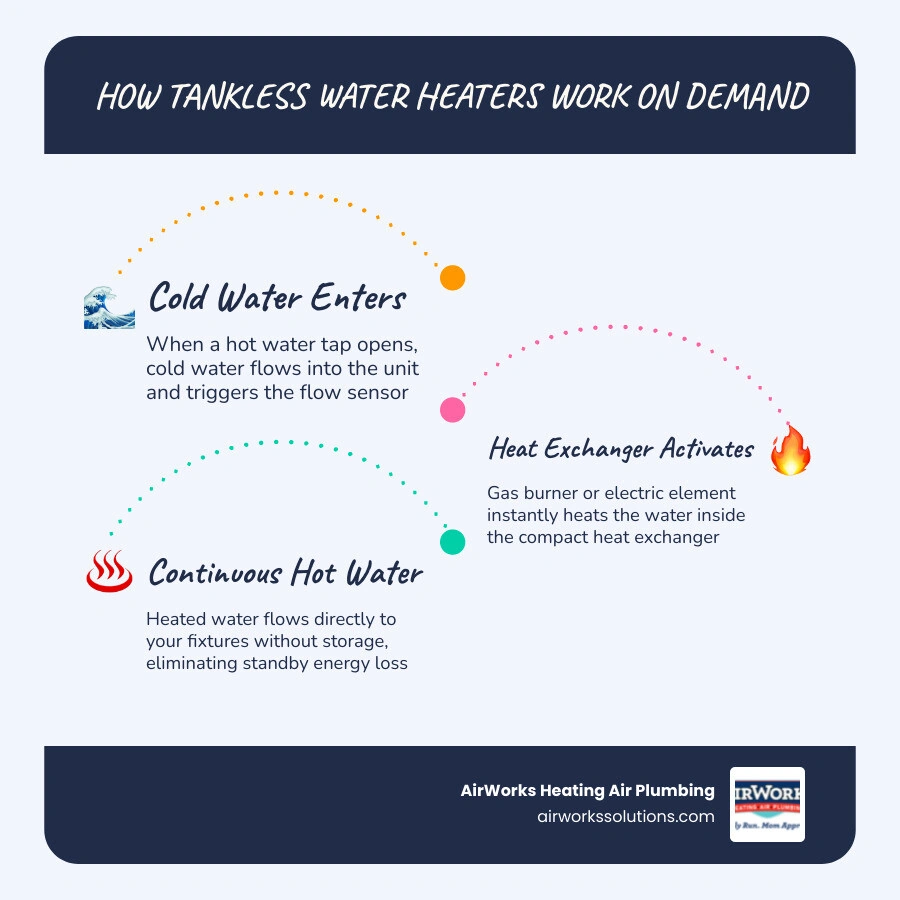
In contrast, a tankless water heater remains completely idle until a hot water tap is opened. Opening a faucet triggers a flow sensor within the unit, which detects that water is moving through the pipes. This flow-activated sensor immediately fires up the gas burner or activates the electric heating elements.
As cold water passes through the tightly coiled pipes of the heat exchanger, it absorbs intense heat instantly, delivering a continuous stream of hot water to your tap. The moment you close the faucet, the flow sensor detects the stop, the burners shut down, and energy consumption drops back to absolute zero.
The Pros and Cons of Switching from Tank to Tankless Water Heater
No home upgrade is entirely one-sided. While switching from tank to tankless water heater offers incredible modern conveniences, it also introduces unique engineering requirements. If you are planning an upgrade In Ventura County area, discovering the local installation dynamics is a great place to start. You can learn more about how these systems are integrated by visiting our page on Tankless Water Heater Installation Fillmore CA.
Key Benefits of Going Tankless
The advantages of converting to an on-demand system go far beyond simply avoiding a cold shower.
- Endless Hot Water: Because there is no tank to drain, the hot water keeps flowing for as long as the tap is open. You can run consecutive showers, start the dishwasher, and wash a load of laundry without running out of hot water.
- Dramatic Energy Savings: By eliminating standby energy loss, tankless units are exceptionally efficient. According to the U.S. Department of Energy, tankless systems can be 24% to 34% more energy-efficient than conventional tanks for homes utilizing 41 gallons or less of hot water daily.
- Reclaimed Square Footage: Tankless units are roughly the size of a carry-on suitcase and mount directly to the wall. This allows you to reclaim valuable closet, garage, or utility room floor space.
- Reduced Flood Risk: A traditional tank holds dozens of gallons of pressurized water. When a tank fails—which nearly 75% of them eventually do by rusting out or bursting—it can cause thousands of dollars in water damage to flooring, drywall, and nearby belongings. A tankless system holds almost no standing water, virtually eliminating catastrophic indoor flooding risks.
- Extended Lifespan: While a standard tank typically lasts 8 to 12 years, a high-quality tankless unit can easily last 20 to 25 years when properly maintained.
Potential Drawbacks to Consider
To make a balanced decision, it is essential to look at the practical challenges associated with tankless conversions.
- Higher Upfront Investment: The initial equipment and conversion process are more complex than simply dropping in a replacement tank.
- Dependency on Electricity: Even gas-powered tankless water heaters require a small amount of electricity to operate the digital control board, sensors, and electronic ignition. If the power goes out, you will not have hot water unless you have a backup power source.
- The "Cold-Water Sandwich" Effect: If you turn a hot water tap off and immediately back on, a small pocket of cold water that was sitting in the heat exchanger during the brief pause can travel through the line, resulting in a momentary dip in temperature.
- Stricter Maintenance Needs: Tankless units are highly sensitive to mineral scale buildup. To protect your warranty and ensure peak performance, they require annual flushing.
Key Infrastructure Upgrades and Sizing for Your Conversion
A successful conversion is not a plug-and-play project. Because tankless systems must heat water instantaneously, they require a massive, rapid burst of energy. This means your home's existing gas, venting, and electrical lines will likely need to be upgraded to support the new system. To get a head start on calculating your home's hot water requirements, you can read our guide on What Size Water Heater Do I Need.
Sizing Your System When Switching from tank to tankless water heater
Sizing a traditional tank is simple: you pick a 40, 50, or 80-gallon drum based on how many people live in your house. Tankless sizing, however, is calculated by peak simultaneous demand in Gallons Per Minute (GPM) and the required temperature rise.
To size your system correctly, we calculate the flow rates of all the hot water fixtures you might run at the exact same time:
- Standard shower head: 2.0 to 2.5 GPM
- Water-saving shower head: 1.5 to 1.8 GPM
- Kitchen faucet: 1.5 to 2.0 GPM
- Bathroom faucet: 0.5 to 1.5 GPM
- Dishwasher: 1.0 to 2.0 GPM
- Washing machine: 1.5 to 2.5 GPM
Next, we must factor in your local groundwater temperature. In Southern California, our winter groundwater temperatures rarely drop below 50°F to 55°F. To reach a comfortable shower temperature of 120°F, your system needs to achieve a "temperature rise" of roughly 65°F to 70°F.
If you want to run two showers (5.0 GPM total) and a dishwasher (1.5 GPM) simultaneously, your tankless unit must be rated to deliver at least 6.5 GPM at a 70°F temperature rise. If you exceed this capacity, the system will not run out of hot water, but it will automatically restrict the flow rate to ensure the water reaching your taps is fully heated, resulting in lower water pressure.
Necessary Home Infrastructure Upgrades
When we convert a home from a storage tank to an on-demand system, we typically address three core infrastructure categories:
1. Gas Line Upsizing
Your old tank water heater probably operated on a modest 30,000 to 50,000 BTU/hr burner, which easily ran off a standard 1/2-inch gas pipe. A whole-house gas tankless unit, however, requires between 150,000 and 199,000 BTU/hr to heat water instantly. To deliver this volume of fuel, we often must upsize the gas line supplying the unit to a 3/4-inch or 1-inch pipe, and sometimes coordinate with the utility company to ensure your gas meter can handle the increased load.
2. Specialized Venting Modifications
Traditional tank heaters vent their hot exhaust gases naturally up a metal chimney flue. Tankless systems use high-powered fans to push exhaust out.
- Non-Condensing Units: These release extremely hot exhaust and require Category III air-tight, stainless steel venting to prevent corrosion and fire hazards.
- Condensing Units: These route exhaust through a secondary heat exchanger to capture extra heat, cooling the exhaust gases down to under 140°F. This allows us to use specialized PVC or CPVC venting, which can easily be routed through an exterior sidewall.
3. Electrical and Condensate Management
Even gas tankless units require a dedicated, grounded 120V electrical outlet nearby to power the internal computer, sensors, and exhaust fan. Additionally, high-efficiency condensing units produce an acidic liquid byproduct (condensate) as they extract heat from the exhaust. This requires us to install a condensate drain line and an inline neutralizing kit to protect your home's drain pipes from corrosion.
What to Expect When Switching from tank to tankless water heater in Ventura County
Homeowners in Ventura County and the surrounding areas experience unique local conditions that directly impact tankless performance. Our winter groundwater is relatively mild, meaning your system won't have to work quite as hard as it would in freezing climates. However, our region is notorious for hard water.
Mineral scale can quickly coat the delicate heating elements of a tankless heat exchanger, reducing its efficiency and potentially shortening its lifespan if left unaddressed. That is why professional installation and local expertise are so critical. If you reside in the area, you can explore specialized local options on our Tankless Water Heater Installation Somis CA service page.
Frequently Asked Questions About Tankless Conversions
Making the transition to on-demand hot water often brings up practical questions about daily usage, maintenance, and system reliability.
How does hard water affect a tankless water heater?
Hard water contains elevated levels of calcium and magnesium. When this water is rapidly heated inside a tankless unit, these minerals crystallize and form a hard, chalky scale along the walls of the heat exchanger. Over time, this scale acts as an insulating barrier, forcing the burner to run longer and hotter to heat the same amount of water. This extra thermal stress can eventually crack the heat exchanger.
To protect your system from hard water damage:
- Schedule Annual Descaling: The system should be flushed annually with a food-grade descaling solution or white vinegar to dissolve mineral deposits. If you are experiencing issues or need to schedule a routine flush, our team offers expert Tankless Water Heater Repair Moorpark CA.
- Install a Water Softener: If your local water supply exceeds 7 grains per gallon of hardness, installing a whole-home water softener or a dedicated scale inhibitor upstream of your tankless unit is highly recommended.
Will I have hot water during a power outage?
Unlike a traditional tank heater, which can keep its stored water hot for hours without electricity (and can fire its gas burner using a pilot light or thermocouple), a standard gas tankless water heater will not operate during a power outage. The digital control board must be powered to open the gas valves, detect water flow, and spark the electronic ignition.
If you live in an area prone to seasonal power outages, you can easily resolve this by plugging your tankless unit into a dedicated uninterruptible power supply (UPS) battery backup or connecting it to a portable generator. Because the electrical draw of a gas tankless unit is very low, a small backup battery can keep your hot water running for several days of normal use.
How long does the professional conversion process take?
A standard tank-to-tankless conversion is a comprehensive home upgrade that typically takes between 8 and 10 hours of active labor. During this window, our professional installation team will:
- Safely shut off the water, gas, and power lines.
- Drain, disconnect, and haul away your old, bulky tank.
- Mount the new tankless unit securely to the wall.
- Run the upgraded gas lines and install the new direct-vent system.
- Connect the water lines, pressure relief valves, and condensate drains.
- Install a dedicated electrical outlet if one is not already present.
- Thoroughly pressure-test all gas and water connections.
- Calibrate the system, program the temperature settings, and walk you through its operation.
Because this process involves high-pressure gas lines, complex venting, and strict local building codes, professional installation is essential to protect your home and keep your manufacturer's warranty fully intact. If you are located in the southern portion of our service area, you can find prompt assistance on our Tankless Water Heater Repair Agoura Hills CA page.
Conclusion
Switching from a tank to a tankless water heater is a premier home improvement that rewards you with endless hot water, reduced utility bills, reclaimed space, and long-term peace of mind. While the conversion requires careful planning and precise infrastructure upgrades, the long-term benefits make it an incredibly smart investment for many modern households.
At AirWorks Heating, Air & Plumbing, we have been delivering honest, customer-focused, and reliable plumbing, heating, and AC services across and Ventura County since 2010. Our highly trained, certified plumbers understand the local water conditions, climate dynamics, and building codes inside and out. We are here to perform a meticulous load calculation, assess your home's current gas and electrical infrastructure, and help you choose the absolute perfect water heating system for your family's daily needs.
Ready to say goodbye to cold showers and bulky tanks? Schedule professional plumbing services with AirWorks Heating, Air & Plumbing today to book an in-home assessment with our friendly, expert team!
About the Author
Kevin Allen
Co-Founder & Service Lead
Co-founded AirWorks in 2010 and has worked in Ventura County HVAC since 2002. Leads the service and installation crews — and the fix-what's-actually-broken ethic the company was built on.
Need Help?
Contact us today to discuss your needs. Our team is ready to help.
Related Articles
Options Comparisons for Homeowners: Heat Pump vs. Gas Furnace
Read Options Comparisons for Homeowners: Heat Pump vs. Gas FurnaceWhy Is Your Air Conditioner Hissing When Off? Causes and Diagnostics
Read Why Is Your Air Conditioner Hissing When Off? Causes and DiagnosticsHeat Pump vs. Gas Furnace: Technical Options Comparisons for Homeowners
Read Heat Pump vs. Gas Furnace: Technical Options Comparisons for HomeownersReady to Get Started?
Whether you need a repair, maintenance, or a new installation, our expert team is here to help.