
The Great Water Heater Debate Tankless vs Traditional Tanks
Kevin Allen
Co-Founder & Service Lead

The Great Water Heater Debate: Tankless vs. Traditional Tanks
A tankless vs tank water heater comparison comes down to a few key trade-offs: upfront cost and simplicity versus long-term efficiency and endless hot water. Here's a quick breakdown to help you decide:
| Factor | Tank Water Heater | Tankless Water Heater |
|---|---|---|
| Hot water supply | Limited by tank size | Unlimited, on demand |
| Energy efficiency | Lower (standby heat loss) | Higher (heats only when needed) |
| Lifespan | 8-15 years | 15-20+ years |
| Space required | Large floor footprint | Compact, wall-mounted |
| Upfront cost | Lower | Higher |
| Best for | High simultaneous demand | Staggered or moderate usage |
| Maintenance | Sediment flushing, anode rod checks | Annual descaling required |
Most homeowners in Ventura County are surprised to learn just how much hot water their household actually uses — and how much energy goes to waste keeping a full tank warm around the clock. Traditional storage tank water heaters work by constantly heating a reservoir of 40 to 80 gallons, even at 2 a.m. when no one is awake to use it. That continuous energy draw is called standby heat loss, and it quietly adds up on your utility bill month after month.
Tankless systems take a completely different approach. Instead of storing hot water, they heat it instantly as it flows through the unit — only using energy when you actually turn on a faucet. The appeal is real: no standby loss, a much longer expected lifespan, and hot water that doesn't run out mid-shower. But tankless units aren't a perfect fit for every home or every household, and the right choice depends on your specific usage habits, home setup, and how long you plan to stay in your home.
I’m Kevin Allen. I’ve been working on HVAC systems in Ventura County since 2002, and I co-founded AirWorks in 2010. In the sections below, we’ll walk you through everything you need to make a confident, well-informed decision.

I'm looking to upgrade my water heater. How do I start a tankless vs tank water heater comparison?

When we sit down with homeowners in places like Oxnard or Thousand Oaks, we start the comparison by looking at "GPM" or Gallons Per Minute. This is the heartbeat of a tankless system. Unlike a traditional tank that gives you a big "bucket" of hot water to use until it's gone, a tankless unit heats water as it moves.
To start your comparison, you need to count your fixtures. A typical shower uses about 2.5 GPM, and a dishwasher might use another 1.5 GPM. If you want to run both at once, you need a unit that can handle at least 4.0 GPM. In our April 2026 climate, groundwater temperatures in Northern and Southern California can vary, which affects how hard the heater has to work. Gas-fired tankless models generally produce higher flow rates than electric ones, making them a popular choice for Water Heater Installation Oxnard when families need to support multiple bathrooms.
How does a tankless vs tank water heater comparison impact my monthly energy usage?
Energy efficiency is where the tankless vs tank water heater comparison really shines. We look at the Uniform Energy Factor (UEF) to determine how much energy is actually turning into hot water versus being wasted.
Tankless water heaters are incredibly efficient—often between 95% and 99% for top-tier models. Because they eliminate standby energy loss (the energy used to keep 50 gallons of water hot while you sleep), they can be 24% to 34% more energy efficient for homes using 41 gallons or less of hot water daily. Even in larger households using around 86 gallons a day, you can still see an 8% to 14% improvement in efficiency. If you are considering a Tankless Water Heater Installation Folsom, these percentages translate directly into lower monthly gas or electric bills.
Which unit wins the tankless vs tank water heater comparison for small utility closets?
If you live in a home where every square foot counts, there is no contest. A traditional tank is a behemoth, usually standing about 5 to 6 feet tall and 2 feet wide. It requires a significant "footprint" on your floor.
In contrast, a tankless unit is about the size of a small suitcase—roughly 20 inches wide and 28 inches tall. Because it is wall-mounted, it frees up all that floor space for storage, a folding table, or just extra breathing room. For homeowners seeking a Tankless Water Heater Installation Goleta, the ability to move the water heater off the floor and onto a wall is often the deciding factor in a renovation.
Lifespan and Durability: Which System Lasts Longer in 2026?
As of April 2026, we are seeing that the long-term value of a water heater is heavily dictated by its lifespan. A traditional tank water heater typically lasts between 8 and 12 years. The primary reason they fail is corrosion. Since water sits in the tank 24/7, the metal eventually gives way. These units use a "sacrificial anode rod" to attract corrosive elements, but once that rod is spent, the tank itself starts to rust. Nearly 75% of tank water heaters eventually burst or leak, which can spill 30 to 80 gallons of water into your home.
Tankless water heaters have a significant advantage here. Most models have a life expectancy of 20 years or more. Because they don't store water, the risk of the unit "bursting" and flooding your home is almost non-existent. Furthermore, tankless units are built with replaceable parts. If a single component fails, we can often repair it. With a tank, once the shell leaks, the whole thing has to go. If you are looking for a Water Heater Repair Thousand Oaks, it is important to know if your unit is nearing the end of its natural life or if a simple part replacement can keep it going.
Performance and Hot Water Delivery for Large Households
For large families, the "performance" part of the tankless vs tank water heater comparison is vital. Here is how they stack up in a real-world scenario:
| Feature | Traditional Tank | Tankless |
|---|---|---|
| Simultaneous Use | Excellent (until the tank is empty) | Depends on GPM capacity |
| Endless Hot Water | No (requires recovery time) | Yes (as long as the gas/electricity is on) |
| Initial Wait Time | Short (hot water is already in pipes) | Slightly longer (unit must ignite and heat) |
| Risk of Cold Water | High (after back-to-back showers) | Minimal (except for "cold water sandwich") |
One phenomenon unique to tankless is the "cold water sandwich." This happens if someone turns the shower off and then right back on; a small pocket of unheated water can get stuck in the pipes between the two heating cycles. However, for a family with four teenagers all needing showers in the morning, a tankless unit is the only way to ensure the last person doesn't get a freezing surprise. If your home currently relies on a 20 Gallon Hot Water Heater, you likely already know the frustration of limited capacity. Upgrading to a tankless system provides that "endless" luxury.
Maintenance Requirements and the Impact of Hard Water
No water heater is truly "maintenance-free." In the Sacramento area, we deal with hard water, which contains minerals like calcium and magnesium. When water is heated, these minerals solidify and create "scale."
In a traditional tank, scale settles at the bottom. This creates a layer of sediment that acts as an insulator, making the burner work harder and eventually causing the tank to overheat and crack. We recommend a sediment flush every year or two to keep things running smoothly.
Tankless units are a bit more "fussy" when it comes to hard water. Because they use small, high-efficiency heat exchangers, mineral buildup can quickly clog the system. An annual "descaling" or "vinegar flush" is mandatory to maintain the warranty and the 20-year lifespan. If you ignore this, the unit's efficiency will drop, and the heat exchanger could fail prematurely. For those in rural areas needing Water Heater Repair Wilton, we often find that a water softener is the best partner for a tankless system to ensure it lasts for decades.
Conclusion
At AirWorks Heating, Air & Plumbing, we’ve been helping families across since 2010. Whether you are in the oak-lined streets of Thousand Oaks or the growing neighborhoods of Rocklin, we believe in providing honest, reliable advice. The tankless vs tank water heater comparison isn't about finding a "winner"—it's about finding the right fit for your home.
When you choose us for your plumbing needs, you get:
- Over a decade of local expertise in California’s unique climate.
- Honest assessments of whether your home’s gas or electrical lines can support a tankless upgrade.
- Professional, customer-focused technicians who respect your time and your home.
- Reliable maintenance plans to protect your investment for the next 20 years.
Frequently Asked Questions about Water Heating
How long does a tankless water heater last compared to a tank?A tankless water heater typically lasts 15-20 years (and sometimes up to 25 with perfect care), whereas a traditional tank usually lasts 8-12 years. The ability to repair individual parts in a tankless unit gives it a much longer "serviceable" life.
Can a tankless system handle multiple showers at once?Yes, provided it is sized correctly. A unit with a higher GPM (Gallons Per Minute) rating is necessary for households that want to run a shower, the laundry, and the dishwasher simultaneously. Gas models are usually better for this than electric ones.
Does hard water affect tankless units more than traditional tanks?Hard water is tough on both, but it can cause a tankless unit to fail faster because the heating elements are more compact. Annual descaling is essential in hard water areas like Sacramento to prevent mineral buildup from clogging the heat exchanger.
Expert Guidance for Your Home
Choosing between a tank and a tankless system is a big decision that affects your comfort for the next decade or more. If you're ready to see which system makes the most sense for your floor plan and your family, we are here to help.
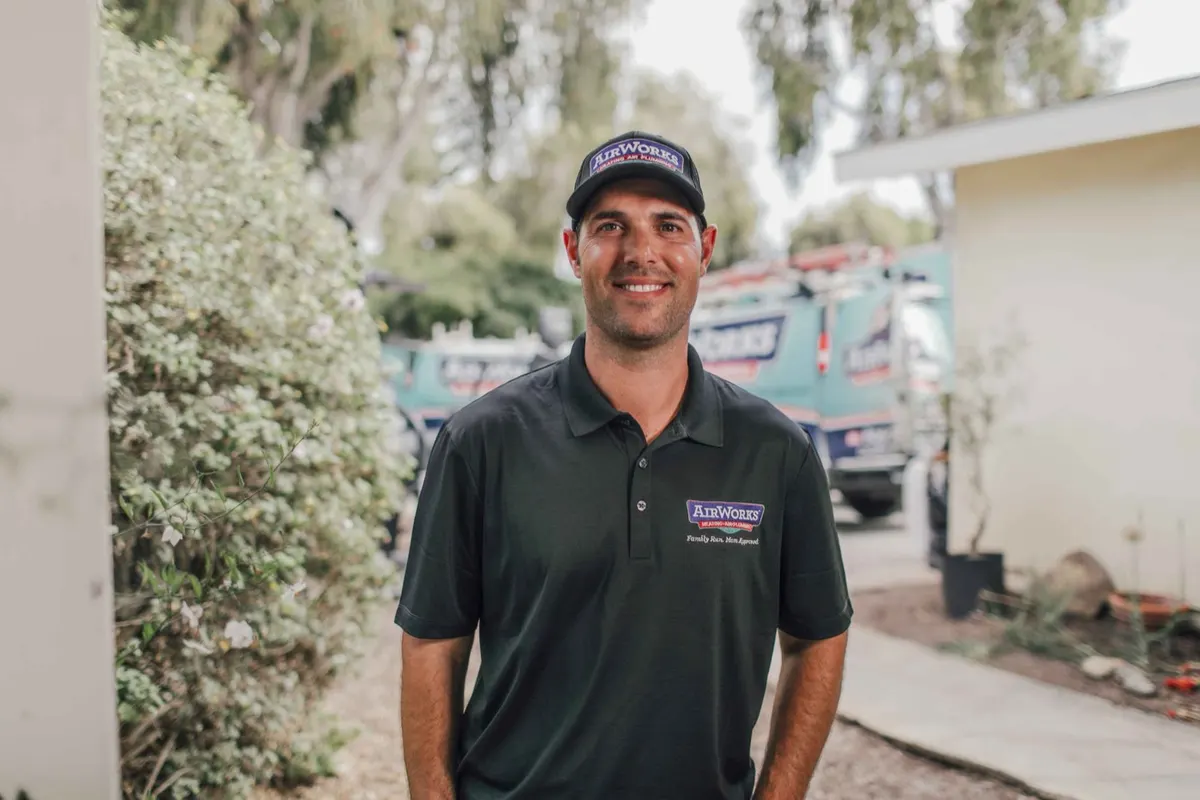
About the Author
Kevin Allen
Co-Founder & Service Lead
Co-founded AirWorks in 2010 and has worked in Ventura County HVAC since 2002. Leads the service and installation crews — and the fix-what's-actually-broken ethic the company was built on.
Need Help?
Contact us today to discuss your needs. Our team is ready to help.
Related Articles
Options Comparisons for Homeowners: Heat Pump vs. Gas Furnace
Read Options Comparisons for Homeowners: Heat Pump vs. Gas FurnaceWhy Is Your Air Conditioner Hissing When Off? Causes and Diagnostics
Read Why Is Your Air Conditioner Hissing When Off? Causes and DiagnosticsHeat Pump vs. Gas Furnace: Technical Options Comparisons for Homeowners
Read Heat Pump vs. Gas Furnace: Technical Options Comparisons for HomeownersReady to Get Started?
Whether you need a repair, maintenance, or a new installation, our expert team is here to help.