Don't Get Left in the Cold: Sizing Your Water Heater
Kevin Allen
Co-Founder & Service Lead

Why Getting Your Water Heater Size Right Matters More Than You Think
What size water heater do I need is one of the most important questions you can ask before replacing or upgrading your system. Choose wrong, and you're either stuck with cold showers or paying to heat water you never use.
Here's a quick answer based on household size:
| Household Size | Recommended Tank Size |
|---|---|
| 1-2 people | 30-40 gallons |
| 2-3 people | 40-50 gallons |
| 3-4 people | 50-60 gallons |
| 4-5 people | 60-75 gallons |
| 5+ people | 75-80+ gallons |
For tankless systems, aim for 6-8 GPM for 1-2 people, scaling up by roughly 1 GPM per additional person.
These are starting points. Your actual needs depend on peak usage habits, appliances, and — especially here in Ventura County — your local inlet water temperature.
Water heating accounts for roughly 18% of a home's total energy use. That means a poorly sized unit doesn't just affect your comfort — it quietly drives up your utility bill every single month. Too small, and your tank runs out during the morning rush. Too large, and you're paying standby energy losses around the clock to keep water hot that nobody's using.
Whether you're replacing an aging tank or considering a switch to tankless, getting the sizing right from the start saves you from a frustrating and expensive do-over.
I’m Kevin Allen, co-founder of AirWorks. I started in commercial HVAC across Ventura County in 2002. Let’s walk through exactly how to figure out the right fit for your home.


When we talk to homeowners about what size water heater do I need, the conversation usually starts with the number of people in the house. While that is a great baseline, it isn't the whole story. In the Sacramento area, from the suburban streets of Orangevale to the more rural properties in Sloughhouse, we see a wide variety of usage patterns that can drastically change your requirements.
Family Size vs. Real-World Demand
As of May 2026, modern households are using more hot water than ever, even with high-efficiency appliances. A standard recommendation for a family of three might be a 50-gallon tank, but what if all three people shower at 7:00 AM? This "simultaneous usage" is the real test of a water heater.
If you have a growing family, we often suggest looking one "size" up. For example, if you are currently two people but plan on expanding, opting for a 50-gallon unit over a 40-gallon unit during a Water Heater Installation Orangevale CA can save you from needing a premature replacement in just a few years.
The Number of Bathrooms and Fixtures
The number of bathrooms in your home acts as a multiplier for your hot water needs. A home with four bathrooms has a much higher potential for simultaneous demand than a two-bathroom home, regardless of the number of occupants. When we perform a Water Heater Installation Sloughhouse CA, we look at:
- The type of showerheads: Standard showerheads use about 2.5 gallons per minute (GPM), but luxury rain heads can use significantly more.
- Bathtub capacity: If you have a large soaking tub or a whirlpool, a standard 40-gallon tank may not even be able to fill it halfway with hot water.
- High-demand appliances: Modern dishwashers and clothes washers are efficient, but they still require a specific "slug" of hot water to start their cycles effectively.
Recovery Rate: The Secret Metric
Many people focus solely on the tank's volume, but the recovery rate is just as vital. This is the amount of water the heater can raise by 90 degrees Fahrenheit in one hour. Gas water heaters generally have a much faster recovery rate than electric ones. If you have a high-demand household, a gas-powered 50-gallon tank might actually outperform a 65-gallon electric tank because it can "keep up" with back-to-back showers more effectively.
Calculating Peak Hour Demand for Ventura County Households
To truly answer what size water heater do I need, we have to move past "gallons" and start talking about "Peak Hour Demand." This is the maximum amount of hot water your home uses during its busiest hour of the day—usually that frantic window between 6:30 AM and 7:30 AM.
Understanding the First-Hour Rating (FHR)
When you look at a new water heater at a store or on a manufacturer’s site, you will see a "First-Hour Rating" on the EnergyGuide label. This number represents the total amount of hot water the unit can supply in a single hour, starting with a full tank. It combines the tank capacity with the recovery rate.
To size your home correctly, your Peak Hour Demand should be less than or equal to the water heater’s FHR. For a Water Heater Installation Camarillo CA, we use a worksheet to help homeowners calculate this.
The Peak Hour Worksheet
You can estimate your own peak demand by adding up the following average usages for your busiest hour:
- Shower: 20 gallons
- Bath: 20 gallons (or half the tub capacity)
- Shaving: 2 gallons
- Hand dishwashing: 4 gallons
- Automatic dishwasher: 6-10 gallons
- Clothes washer: 15-25 gallons
For example, if two people shower (40 gallons) while the dishwasher runs (10 gallons) and someone shaves (2 gallons), your Peak Hour Demand is 52 gallons. In this case, you would need a water heater with an FHR of at least 52. When we handle a Water Heater Installation North Ranch CA, we often find that luxury homes with high-flow fixtures require an FHR of 80 or higher.
Why the EnergyGuide Label is Your Best Friend
Don't just look at the "50 Gallon" sticker on the front of the tank. The EnergyGuide label provides the FHR, which is the legally verified performance metric. It also gives you an idea of the annual operating cost. In Ventura County, where energy efficiency is a top priority for many of our clients, choosing a unit with a high FHR but a low operating cost is the "sweet spot" for long-term satisfaction.
Sizing Tankless Systems for Homes in Ojai and Santa Paula
If you are tired of the "who gets the last shower" game, a tankless system might be the answer. However, sizing a tankless unit is completely different from sizing a tank. Instead of "how much can it hold," the question becomes "how much can it heat at once?"
Flow Rate and GPM
Tankless water heaters are rated in Gallons Per Minute (GPM). To find out what GPM you need, you simply add up the flow rates of all the fixtures you want to use at the exact same time.
- Bathroom Faucet: 0.5 – 1.5 GPM
- Kitchen Faucet: 1.0 – 2.2 GPM
- Shower: 2.0 – 2.5 GPM
- Dishwasher: 1.0 – 2.0 GPM
If you want to be able to run two showers (5.0 GPM) and the kitchen sink (2.0 GPM) simultaneously, you need a unit that can handle at least 7.0 GPM. During a Tankless Water Heater Installation Ojai CA, we carefully audit these fixtures to ensure the client never experiences a "cold sandwich" — that annoying burst of cold water when someone else turns on a tap.
The Importance of Temperature Rise
This is where it gets technical. GPM isn't a fixed number; it depends on how much the heater has to raise the temperature of the incoming water.
- Desired Output: Usually 120°F.
- Inlet Temperature: The temperature of the water coming from the city or well.
In Santa Paula, the groundwater might be 65°F in the summer but could drop significantly in the winter. If your inlet water is 50°F and you want it to be 120°F, that’s a "70-degree rise." A tankless unit that provides 7 GPM at a 45-degree rise might only provide 4 GPM at a 70-degree rise. This is why professional sizing for a Water Heater Installation Santa Paula CA is so important—we account for those winter temperature drops so you aren't left with lukewarm showers in January.
Space and Infrastructure
One of the biggest perks of tankless systems is their size. They are about the size of a suitcase and mount to the wall, which is great for smaller homes in Santa Paula or Ojai where floor space is at a premium. However, they often require larger gas lines or specific electrical upgrades. We always check your home’s existing infrastructure to see if a tankless upgrade is a straightforward swap or if it requires additional modifications.
Signs Your Current System is Undersized or Failing
Sometimes the question isn't what size water heater do I need for a new home, but rather "is my current one actually the right size?" Many homes were built with "builder grade" tanks that were sized for the bare minimum requirements, not for the way modern families actually live.
Running Out of Hot Water Regularly
This is the most obvious sign. If the third person in the shower always gets a cold surprise, your tank's FHR is likely lower than your Peak Hour Demand. Over time, sediment buildup inside the tank can also reduce the actual volume of water available, effectively "shrinking" your water heater. If you're experiencing this in Citrus Heights, it might be time for a Water Heater Repair Citrus Heights CA to flush the system, or it may be time for an upgrade.
Long Wait Times for Reheating
Does it take two hours for your water to get hot again after someone takes a bath? This points to a poor recovery rate. As heating elements in electric heaters or burners in gas heaters age, they become less efficient. In Thousand Oaks, we often see older units struggling to keep up with demand even if the tank size seems correct. A Water Heater Repair Thousand Oaks CA can often identify if a simple part replacement can fix the recovery issue or if the unit is simply reaching the end of its lifespan.
Physical Signs of Trouble
- Leaking around the base: This usually indicates a breached inner tank, which cannot be repaired.
- Rusty water: This suggests the internal sacrificial anode rod has failed and the tank is corroding from the inside out.
- Popping or rumbling noises: This is the sound of steam bubbles pushing through a layer of sediment at the bottom of the tank. It’s a sign of extreme inefficiency.
Standby Losses and Efficiency
Older tanks have much thinner insulation than the models available in May 2026. If your water heater closet feels like a sauna, that’s heat escaping the tank—energy you paid for that is now just warming up your garage or utility room. Upgrading to a properly sized, modern unit with better insulation or a heat pump model can drastically reduce these standby losses.
Frequently Asked Questions about Water Heater Sizing
What size water heater do i need for a family of four?
For a typical family of four, we generally recommend a 50 to 60-gallon tank for gas or electric storage heaters. However, if your family includes teenagers who take long showers or if you have a high-capacity washing machine, a 75-gallon tank or a tankless system is often a better fit.
A family of four can easily use 100 gallons of hot water in a single day. If everyone tries to get ready within the same hour, a 40-gallon tank will almost certainly fail the test. When we provide a Water Heater Repair Westlake Village CA, we often find that "repairs" are actually just homeowners hitting the limit of an undersized 40-gallon tank that was installed when the house was built.
How do I calculate what size water heater do i need for my appliances?
Appliances don't just use "water"; they use "flow."
- Dishwashers: Usually require 1-2 GPM. If yours doesn't have an internal heater, it needs the water heater to deliver at least 120°F-140°F immediately.
- Washing Machines: Older top-loaders can use up to 25 gallons of hot water per load. Modern front-loaders are much more efficient, using around 10 gallons.
To calculate the size, look at your "worst-case scenario." If you plan to run the dishwasher and the laundry at the same time someone is showering, you need to add those GPM requirements together. For homeowners in Antelope, a Tankless Water Heater Repair Antelope CA often reveals that the system is working perfectly, but the homeowner is simply trying to run too many appliances at once for the unit's rated GPM.
Does climate affect my water heater size?
Yes, climate is a huge factor! In Northern and Central California, our groundwater temperatures fluctuate.
- In the summer: Ground water is warmer, so your heater doesn't have to work as hard.
- In the winter: The water entering your home can be 20 degrees colder.
This means in the winter, your water heater takes longer to recover (tank) or provides fewer GPM (tankless). If you live in a cooler area like Rancho Cordova, we might suggest a slightly larger unit than we would for someone in a consistently warmer coastal climate. This ensures that even on the coldest morning of the year, your shower stays hot. If you're noticing seasonal fluctuations in your hot water supply, a Water Heater Repair Rancho Cordova CA can help determine if your settings need adjustment or if your unit is struggling with the temperature rise.
Conclusion
Finding the perfect answer to what size water heater do I need is about more than just picking a number off a shelf. It’s about understanding your family’s unique rhythm, the specific fixtures in your home, and the climate of Ventura County.
At AirWorks Heating Air Plumbing, we’ve spent over 15 years helping our neighbors in Agoura Hills, Simi Valley, Citrus Heights, and beyond find reliable, energy-efficient solutions for their homes. Whether you need a quick repair to get through the week or a full system replacement to ensure you never run out of hot water again, we are here to provide honest, expert advice.
Don't spend another morning negotiating for the first shower. Let us help you size a system that fits your life perfectly. If you're ready to upgrade your comfort, explore our full range of Plumbing Services or give us a call to schedule a professional sizing consultation today.
About the Author
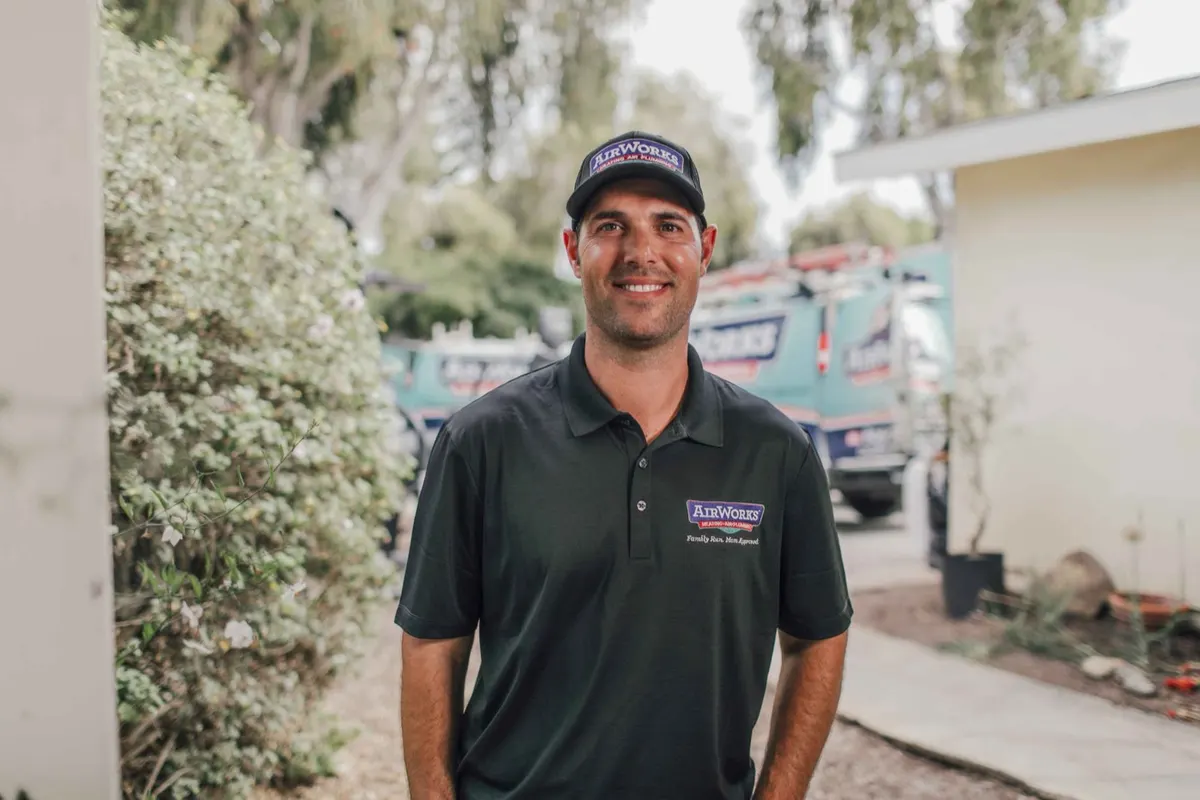
Kevin Allen
Co-Founder & Service Lead
Co-founded AirWorks in 2010 and has worked in Ventura County HVAC since 2002. Leads the service and installation crews — and the fix-what's-actually-broken ethic the company was built on.
Need Help?
Contact us today to discuss your needs. Our team is ready to help.
Related Articles
Options Comparisons for Homeowners: Heat Pump vs. Gas Furnace
Read Options Comparisons for Homeowners: Heat Pump vs. Gas FurnaceWhy Is Your Air Conditioner Hissing When Off? Causes and Diagnostics
Read Why Is Your Air Conditioner Hissing When Off? Causes and DiagnosticsHeat Pump vs. Gas Furnace: Technical Options Comparisons for Homeowners
Read Heat Pump vs. Gas Furnace: Technical Options Comparisons for HomeownersReady to Get Started?
Whether you need a repair, maintenance, or a new installation, our expert team is here to help.