
How to Extend Your Water Heater Lifespan in 5 Simple Steps
Kevin Allen
Co-Founder & Service Lead

Learn how to extend the life of your water heater with 5 simple maintenance steps that prevent corrosion, sediment, and costly breakdowns.
Why Knowing How to Extend the Life of Your Water Heater Could Save You From a Costly Surprise
How to extend the life of your water heater comes down to a handful of simple habits most homeowners never think about — until cold water is all that's coming out of the tap.
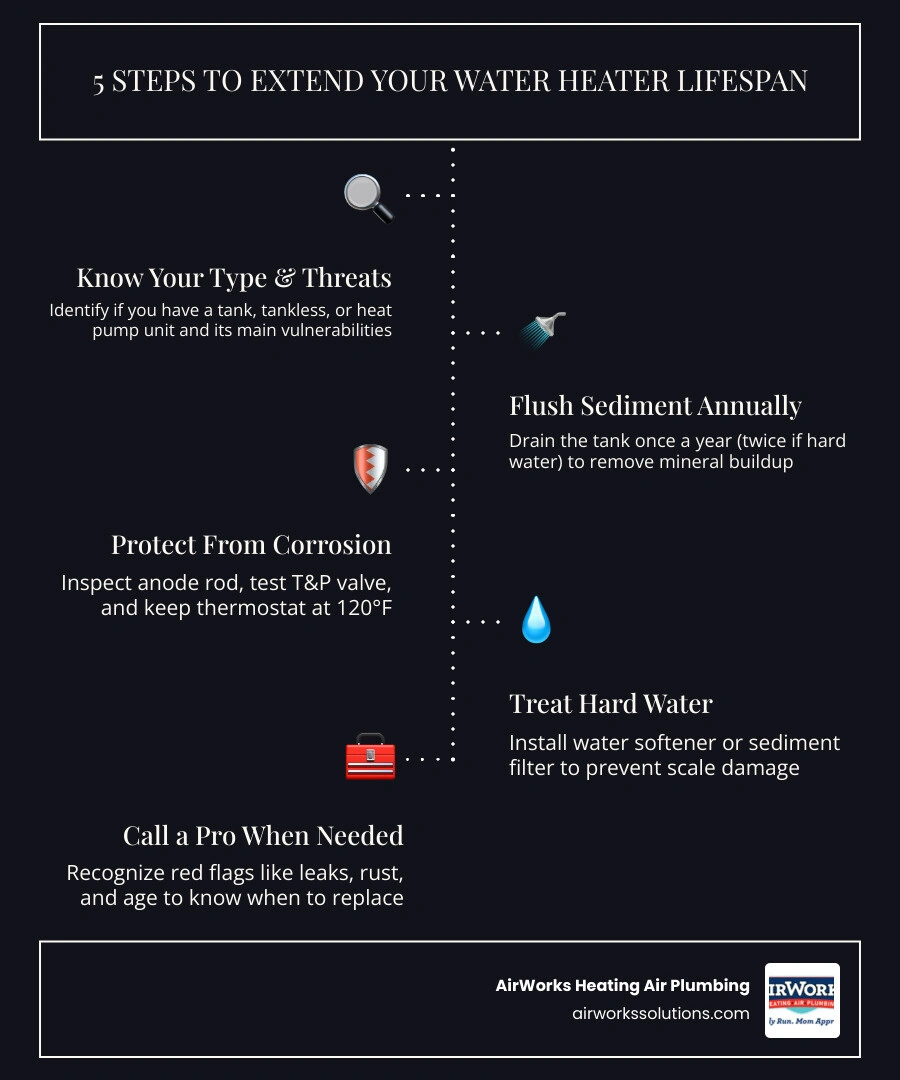
Here are the five core steps that make the biggest difference:
- Know your water heater type and its biggest threats — tank, tankless, and heat pump units each have different vulnerabilities
- Flush sediment on schedule — once a year for most homes, twice a year if you have hard water
- Protect the tank from corrosion, pressure, and unsafe temperatures — inspect the anode rod, test the T&P valve, and keep the thermostat at 120°F
- Fix water quality problems before they damage the unit — hard water is one of the fastest ways to shorten a water heater's life
- Know when to call a plumber — some problems need a professional before they become emergencies
A well-maintained water heater can last 12 years or more. One that's been ignored might fail in as little as 6 to 8 years. The difference usually comes down to a few hours of attention spread across the life of the unit.
Most homeowners don't think about their water heater until something goes wrong — a cold shower, water pooling on the floor, or a utility bill that doesn't make sense. By then, the damage is often already done and the options are limited to repair or replacement.
The good news is that most of what shortens a water heater's life is completely preventable. Sediment builds up slowly. Anode rods wear down gradually. Pressure creeps up quietly. None of these things happen overnight, which means there's always time to get ahead of them — if you know what to look for.
I’m Kevin Allen, co-founder of AirWorks, and our service and installation crews report to me. In this guide, we’ll walk you through every step so you can protect one of your home’s hardest-working appliances.
Key how to extend the life of your water heater vocabulary:
Step 1: Know Your Water Heater’s Expected Lifespan and Biggest Threats
Before we can dive into the "how," we need to understand the "what" and the "why." Not all water heaters are built the same, and the threats they face depend heavily on their design and the environment they live in. In May 2026, we are seeing more diverse technology in homes than ever before, from traditional gas tanks in Simi Valley to high-efficiency heat pumps in Sacramento.
How to extend the life of your water heater starts with knowing its type
The first step in how to extend the life of your water heater is identifying which model you have. Each has a different "natural" expiration date:
- Traditional Tank Water Heaters: These are the most common. They store 30 to 50 gallons of water and keep it hot 24/7. Because they always hold water, they are the most susceptible to internal corrosion and sediment buildup. They typically last 8–12 years.
- Tankless Water Heaters: These units heat water on demand. Since they don't store water, they don't have a tank to rust out. However, they are highly sensitive to mineral scale. With proper care, they can last 15–20 years or more.
- Heat Pump (Hybrid) Water Heaters: These use electricity to move heat from the air into the water. They are incredibly efficient but have more moving parts (like a compressor and air filters) that need attention. Their lifespan is usually 10–15 years.
| Water Heater Type | Average Lifespan (Maintained) | Primary Threat |
|---|---|---|
| Traditional Tank | 10–15 Years | Internal Corrosion & Sediment |
| Tankless | 15–25 Years | Mineral Scale Buildup |
| Heat Pump (Hybrid) | 10–15 Years | Component Failure & Airflow |
What shortens water heater life fastest
If you want to know how long does a water heater last, you have to look at the "killers." In our experience serving areas like Thousand Oaks and North Highlands, several factors act as a "fast-forward" button for appliance aging:
- Sediment Buildup: Minerals like calcium and magnesium settle at the bottom of the tank. This creates an insulating layer that forces the burner or element to work harder, eventually overheating and weakening the tank.
- Anode Rod Depletion: This "sacrificial" rod is designed to rust so your tank doesn't. Once it’s gone, the water starts eating your tank walls.
- High Temperatures: Setting your heater above 140°F accelerates mineral scaling and can weaken the internal lining of the tank.
- Pressure Stress: Thermal expansion (water expanding as it heats) can cause the tank to "breathe" or flex. Over time, this leads to hairline cracks, especially during cold snaps when the temperature difference is extreme.
Step 2: Flush Sediment on Schedule to Prevent Wear
Think of flushing your water heater like changing the oil in your car. If you skip it, the "engine" (the heating element or burner) has to work through sludge. This is perhaps the most critical task in how to extend the life of your water heater.
How often should you flush a water heater?
For most homes in, an annual flush is the standard. However, if you live in a region with particularly hard water — like many parts of Roseville or Elk Grove — you should consider a flush every six months.
Pro Tip: If you hear popping, rumbling, or "kettling" noises coming from your tank, that’s the sound of steam bubbles escaping through a thick layer of sediment. It’s a loud cry for help!
How to extend the life of your water heater by flushing it the right way
You can perform a basic flush yourself by following these steps:
- Safety First: Turn off the power (at the breaker for electric) or turn the gas valve to the "Pilot" or "Off" setting.
- Shut off Water: Close the cold water inlet valve.
- Connect a Hose: Attach a standard garden hose to the drain valve at the bottom of the unit. Run the other end to a floor drain or outside.
- Open a Faucet: Turn on a hot water faucet somewhere in the house to prevent a vacuum from forming.
- Drain: Open the drain valve. Let the water flow until it runs clear.
- Refill: Close the drain valve, remove the hose, and turn the cold water supply back on. Wait until the tank is completely full (water should flow steadily from the open hot faucet) before turning the power or gas back on to avoid burning out the elements.
For a deeper dive into these systems, check out our Water Heater Complete Guide.
Tankless and heat pump flushing differences
How to extend the life of your water heater looks a bit different if you’ve gone tankless. Tankless units don't collect "mud" at the bottom, but they do get "scale" (calcium armor) on the heat exchanger. This requires a descaling flush with a food-grade vinegar solution using a small pump.
Heat pump models also need their air filters cleaned every 3–6 months. If the filter is clogged, the heat pump can’t "breathe," forcing it to switch to less-efficient backup electric coils, which adds more stress to the system.
Step 3: Protect the Tank from Corrosion, Pressure, and Unsafe Operation
While flushing handles the "dirt," this step handles the "chemistry." To truly master how to extend the life of your water heater, you have to protect the physical integrity of the vessel.
Why the anode rod matters and when to replace it
The anode rod is your water heater’s best friend. It is a rod made of magnesium or aluminum that hangs inside the tank. Because of a process called electrolysis, the rod corrodes faster than the steel tank.
If you ignore the anode rod, it will eventually disappear, and the water will begin attacking the tank itself. We recommend inspecting the rod every 1–3 years and replacing it every 3–5 years. If you notice a "rotten egg" smell in your hot water or see bits of rust, your anode rod is likely spent. Replacing a rod is a small investment that can literally double the life of your tank.
How to test and maintain the T&P relief valve
The Temperature and Pressure (T&P) relief valve is a safety device located near the top of the tank. Its job is to open and release water if the internal pressure or temperature gets too high, preventing a tank explosion.
To test it:
- Lift the small lever on the valve briefly.
- Water should discharge through the pipe.
- Let go; the valve should snap shut and stop the flow completely.
If it keeps dripping or is stuck "frozen," call us immediately. A faulty T&P valve is a major safety hazard. This is especially important for smaller units like a 20 Gallon Electric Water Heater which can experience rapid pressure changes.
Why 120°F is the best setting for longevity and safety
Most water heaters come from the factory set at 140°F. While this is great for killing bacteria, it's tough on your plumbing. Lowering the thermostat to 120°F:
- Reduces Scale: Mineral buildup happens much faster at higher temperatures.
- Saves Energy: You can save up to 10% on your water heating costs.
- Prevents Scalding: 120°F is much safer for households with children or seniors.
Step 4: Fix Water Quality Problems Before They Damage the Unit
In, "hard water" is a common headache. Hard water contains high levels of dissolved calcium and magnesium. When this water is heated, those minerals solidify into "scale."
How hard water affects your water heater lifespan
Think of scale like a layer of concrete. It coats the electric heating elements, causing them to burn out prematurely. In gas models, it creates a thick crust at the bottom, making the burner run longer and hotter to reach the water. This extra heat eventually "cooks" the tank, leading to metal fatigue and leaks. If you’re seeing white chalky spots on your faucets, your water heater is likely suffering inside.
Best upgrades for extending water heater life
If you want to go the extra mile in how to extend the life of your water heater, consider these upgrades:
- Water Softeners: These remove the hard minerals before they ever reach the heater. This is the single best way to protect a tankless unit.
- Expansion Tanks: If you have a "closed" plumbing system, water has nowhere to go when it expands. An expansion tank provides a "balloon" for that extra volume, preventing pressure spikes.
- Insulation: Wrapping your tank in an insulation blanket and insulating the first 6 feet of hot water pipes keeps heat in, reducing the "cycling" (turning on and off) that wears out components.
Maintenance tasks unique to tankless vs traditional water heaters
Tankless owners need to be diligent about the inlet filter. This small screen catches debris from the city water lines. If it’s clogged, your water pressure drops, and the unit may struggle to ignite. Check this every 6 months. For those in Somis, our Water Heater Repair Somis CA Guide offers more localized tips on dealing with specific regional water issues.
Step 5: Know When Maintenance Is Enough and When to Call a Plumber
Even the most dedicated DIY-er reaches a point where professional help is needed. How to extend the life of your water heater involves knowing when a repair is a "save" and when it's a "lost cause."
Signs your water heater needs repair instead of routine maintenance
Not every problem means you need a new unit. Many parts are replaceable:
- Faulty Thermostats: If your water is suddenly ice cold or dangerously hot.
- Heating Elements: Common on electric models; these can be swapped out easily.
- Pilot Light/Igniter Issues: Often just requires a cleaning or a new thermocouple.
- Leaking Valves: If the drain valve or T&P valve is dripping, we can usually replace just the valve.
If you are in Herald, you might find our Water Heater Repair Herald CA resource helpful for troubleshooting these specific issues.
Signs it’s time to replace the water heater
Sometimes, the best way to "extend" your peace of mind is to replace a failing unit before it floods your garage. Watch for these red flags:
- The 12-Year Mark: If your tank is over 12 years old, it’s on borrowed time.
- Rusty Water: If the rust is only in the hot water, your tank is corroding from the inside out.
- Moisture or Pooling: Any water around the base of the tank (that isn't from a valve) usually means the inner lining has cracked.
- Frequent Repairs: If you’re calling us every few months, the "total cost of ownership" is likely higher than a new, efficient installation.
When homeowners should call a professional plumber
For your safety, always call a pro for:
- Gas Smells: If you smell "rotten eggs" (mercaptan) near a gas heater, leave the house and call us.
- Electrical Issues: If your water heater keeps tripping the circuit breaker.
- Seized Anode Rods: These can be incredibly difficult to remove without an impact wrench.
- No Hot Water: After you've checked the breaker and the pilot light, it's time for a diagnostic.
For specialized units, like those in Ventura County, we offer Tankless Water Heater Repair Thousand Oaks CA to ensure your high-end system is handled correctly.
Frequently Asked Questions about how to extend the life of your water heater
Can maintenance really add years to a water heater?
Absolutely. A neglected water heater typically lasts 6–8 years. A well-maintained unit frequently reaches 12–15 years. That’s nearly double the life for the cost of a few simple annual tasks.
Do tankless water heaters need maintenance too?
Yes! Manufacturers actually require annual descaling to maintain your warranty. Because they use high-intensity heat exchangers, mineral buildup can cause them to overheat and shut down very quickly.
Does insulation help a water heater last longer?
It helps by reducing "standby heat loss." When the water stays hot longer, the burner or elements turn on less frequently. Less "firing" means less wear and tear on the mechanical components.
Conclusion
Learning how to extend the life of your water heater isn't just about saving money — it's about the reliability and safety of your home. By flushing sediment, checking your anode rod, and keeping an eye on water quality, you can enjoy years of hot showers without the "surprise" of a flooded utility room.
At AirWorks Heating, Air & Plumbing, we’ve been providing honest, customer-focused plumbing and HVAC services across since 2010. Whether you need a routine flush in Citrus Heights or a complex tankless water heater installation in Santa Rosa Valley, our team is here to provide reliable solutions you can trust.
Don't wait for the water to turn cold. Take a few minutes this weekend to check your thermostat and inspect your tank. If you see something that doesn't look right, or if you'd rather have an expert handle the "dirty work," we're just a phone call away.

About the Author
Kevin Allen
Co-Founder & Service Lead
Co-founded AirWorks in 2010 and has worked in Ventura County HVAC since 2002. Leads the service and installation crews — and the fix-what's-actually-broken ethic the company was built on.
Need Help?
Contact us today to discuss your needs. Our team is ready to help.
Related Articles
Options Comparisons for Homeowners: Heat Pump vs. Gas Furnace
Read Options Comparisons for Homeowners: Heat Pump vs. Gas FurnaceWhy Is Your Air Conditioner Hissing When Off? Causes and Diagnostics
Read Why Is Your Air Conditioner Hissing When Off? Causes and DiagnosticsHeat Pump vs. Gas Furnace: Technical Options Comparisons for Homeowners
Read Heat Pump vs. Gas Furnace: Technical Options Comparisons for HomeownersReady to Get Started?
Whether you need a repair, maintenance, or a new installation, our expert team is here to help.