Why Is Your AC Running But Not Cooling? The 20-Degree Rule Explained
Kevin Allen
Co-Founder & Service Lead

When Your AC Runs Constantly But the House Stays Warm
A common myth among homeowners is that if your air conditioner runs all afternoon without hitting the target temperature on the thermostat, the system is completely broken. Here at AirWorks Heating Air Plumbing, when we look at common homeowner questions answered during the peak July summer heat, this is easily the most frequent concern we hear from our Somis customers. You set your thermostat to 72°F, but the house is stubbornly sitting at 78°F while the system blasts air non-stop. Is it a mechanical failure, or is it just operating at its absolute maximum design capacity? Before you panic and assume the worst, it helps to understand the physical limits of residential cooling equipment.
If you are experiencing a complete system breakdown where nothing turns on at all, you might need emergency AC repair in Somis. However, in our experience serving the local area, a system running continuously on a scorching afternoon is often simply doing exactly what it was built to do. To understand why, we have to look at the concept of thermal load. When the sun beats down on your roof during a massive heatwave, the amount of heat energy pressing into your home is immense. Your air conditioner's job is to remove that heat, but it can only remove a specific amount of heat per hour.
When the heat entering your home equals the maximum amount of heat your system can remove, the indoor temperature stops dropping. The unit will run continuously just to hold the line and keep the house from getting hotter.
| System Behavior | Normal Capacity Limit | Mechanical Failure Sign |
|---|---|---|
| Running constantly | Outdoor temps exceed 95°F | Mild 75°F day, but won't stop |
| Air from vents | Cool, but not freezing cold | Completely room-temperature or warm |
| Indoor temperature | Holding steady, not rising | Actively rising despite system running |
As we explore this topic, we will walk through how to tell the difference between a system working at its peak capacity and a system that actually needs professional help.
Understanding HVAC Design Temperature and Thermal Load
To truly grasp why your system behaves the way it does, we need to talk about how air conditioners are engineered. Residential HVAC systems are built around a concept called "design temperature." Engineers do not size a home's air conditioner to handle the absolute hottest day of the decade. Instead, they look at historical weather data and build systems to handle the 99th percentile of local summer heat. Somis, CA summer temperatures frequently create high thermal loads that test the limits of standard residential AC design temperatures. Our service technicians see this firsthand every July when local systems are pushed to their absolute maximums.
Because of these engineering standards, standard residential systems are designed to maintain a maximum 20-degree temperature differential between the outdoor ambient air and the indoor air. This is the golden rule of air conditioning. If it is 100°F outside, cooling your house to 80°F means your air conditioner is maxed out and working perfectly. It is physically incapable of dropping the house to 70°F under those specific outdoor conditions. Checking your thermostat set point vs actual indoor ambient temperature differential is the best way to see this rule in action.
The 20-Degree Differential in Action
Think of your air conditioner like a sponge soaking up water. It can only hold so much heat at one time before it has to ring itself out at the outdoor unit. If the heat is pouring into your home faster than the "sponge" can absorb it, the indoor temperature will plateau.
This is why pushing the thermostat lower won't force the system to cool faster. If your house is 80°F on a 105°F day, turning the thermostat down to 68°F does not make the air coming out of the vents any colder. It does not engage a "turbo" mode. It simply tells the system to keep running indefinitely until it reaches 68°F—which, due to the 20-degree rule, it physically cannot do until the sun goes down and the outdoor temperature drops.

Safe Troubleshooting: What Homeowners Can Check First
If you notice that your thermostat set point vs actual indoor ambient temperature differential is widening beyond that normal 20-degree mark, there might be a localized issue preventing the system from absorbing heat. Before assuming the compressor is broken, there are several safe, non-technical items our team recommends you check. If you have a completely unresponsive system, you might want to read our guide on AC Not Turning On? Check These 5 Things First. Otherwise, follow this basic checklist we share with all our customers:
- Verify thermostat settings: Ensure the system is actually set to "Cool" and not accidentally bumped to "Heat." More importantly, check that the fan setting is on "Auto" rather than "On." When the fan is set to "On," it blows air continuously, even when the cooling cycle is resting. This can actually pull humidity back into the house, making it feel warmer than it is.
- Inspect your air filter: A clogged filter is the number one cause of poor cooling performance. Pull the filter out and hold it up to a light. If you cannot see light passing through the material, it is choked with dust and needs immediate replacement.
- Check supply and return vents: Walk through your home and make sure rugs, furniture, or heavy curtains are not blocking the registers. Closing vents in unused rooms actually harms the system by increasing static pressure and throwing off the carefully balanced airflow.
- Minimize heat infiltration: Check that all windows and exterior doors are tightly closed and latched. Close the blinds or draw the curtains on south and west-facing windows during the hottest part of the afternoon to block radiant solar heat.
- Listen for unusual sounds: Stand near the indoor and outdoor units and listen. A steady hum is normal. Grinding, squealing, or violent rattling indicates a mechanical problem that requires a professional.
A critical safety reminder: Never attempt to open the electrical panel on your HVAC equipment, and never handle the copper refrigerant lines. These components carry high voltage and pressurized chemicals that require specialized licensing and safety gear to service.
How Restricted Airflow Halts the Cooling Process
If you have checked the basics and the system is still struggling during the peak July summer heat, the most likely culprit is restricted airflow. To understand why airflow is so critical, you have to look at the evaporator coil located inside your indoor unit. This coil is filled with extremely cold liquid refrigerant.
As warm indoor air blows across this coil, the refrigerant absorbs heat, cooling the air before it is pushed back into your rooms. However, the system requires a very specific airflow volume to function properly. The warm air blowing over the coil is what keeps the refrigerant from getting too cold.
If a dirty air filter severely restricts the amount of air passing through the system, the temperature at the evaporator coil drops rapidly. When it drops below freezing, the natural condensation that forms on the coil turns to ice. This creates a dangerous chain reaction. The ice acts as a thick insulator between the warm air and the cold refrigerant.
Once you have a frozen coil, the cooling process stops entirely. The indoor fan will continue to run, blowing room-temperature air through the house, but no heat is being absorbed. The system will run continuously, wasting electricity, while the house gets warmer and warmer. The only solution is to turn the system completely off, let the ice melt, replace the filter, and restart the unit.
The Role of the Outdoor Condenser in Heat Transfer
While the indoor unit absorbs heat, the outdoor unit—known as the condenser—has the equally important job of releasing that heat. If the outdoor unit cannot exhaust the heat it collected from inside your house, the entire cooling cycle breaks down.
The Problem: Your AC runs constantly during the peak July summer heat, but the air coming from the vents feels lukewarm. The indoor filter is clean, and the thermostat is set correctly.
The Cause: The outdoor condenser coil is designed with hundreds of tiny aluminum fins that help dissipate heat into the outside air. Because this unit sits outside year-round, it is highly susceptible to blockages. Overgrown bushes, tall grass, accumulated dirt, cottonwood seeds, and fallen leaves can easily blanket these fins. When the condenser is choked by debris, the fan cannot pull enough outside air across the hot coils to cool the refrigerant down. If the system cannot release the heat outside, it cannot absorb any more heat inside. The compressor will run continuously, struggling against high pressure, which can eventually cause the motor to burn out.
The Solution: Homeowners should maintain a strict two-foot clearance zone around the entire outdoor unit. Trim back any landscaping, bushes, or tall grass. You can safely turn off the power to the unit and use a standard garden hose on a gentle setting to rinse away loose dust and pollen from the outside fins. Never use a pressure washer, as the high-pressure water will instantly crush the delicate aluminum fins, permanently ruining the unit's ability to transfer heat.
Signs of True Mechanical Failure in Your Cooling System
If you have verified that your filters are clean, your vents are open, and your outdoor unit is clear of debris, but your thermostat set point vs actual indoor ambient temperature differential is still shrinking, you are likely dealing with a true mechanical failure.
One of the most common mechanical issues is a refrigerant leak. It is vital to understand that air conditioning systems do not "consume" or burn off refrigerant like a car burns gas. It operates in a closed, pressurized loop. If your system is low on refrigerant, it means there is a physical hole or micro-leak somewhere in the copper lines or coils. Running a system with low refrigerant will eventually destroy the compressor.
Another frequent point of failure is the dual run capacitor. This small electrical component acts as a massive battery that delivers a jolt of electricity to start the heavy compressor motor. If the capacitor fails, you will hear the indoor fan blowing air, and you might even hear the outdoor fan spinning, but the compressor itself will not engage. Without the compressor pumping refrigerant, no cooling takes place.
We recently helped a local customer who found that their air conditioning system stopped cooling properly even after recent maintenance and a condenser replacement. Our AirWorks Heating Air Plumbing technicians addressed the issue, replacing a failed internal part, and fully tested the system to confirm it was working under heavy load. This highlights the immense value of expert, certified diagnostic testing to accurately differentiate between a simple capacity limit and a genuine mechanical fault. Guesswork can lead to expensive mistakes, which is why professional AC inspection and testing is necessary to pinpoint electrical or mechanical faults safely.
When Continuous Running Means It's Time for an Upgrade
Sometimes, the reason your system runs non-stop isn't a single broken part, but the overall age and deterioration of the equipment.
The Problem: An older AC unit that used to easily handle the peak July summer heat now runs constantly from noon until midnight, yet the house still feels sticky, humid, and warm.
The Cause: Air conditioning systems lose cooling capacity and efficiency as they age. The compressor motor weakens, the coils corrode and lose their heat-transfer efficiency, and the internal components suffer from years of wear and tear. Furthermore, the ductwork delivering the air can deteriorate. Sometimes the issue isn't just the main unit, but the delivery system. During a recent replacement project in cramped Somis attic spaces, our installation team had to replace aging, leaky ducts and registers, while another technician installed a new thermostat and sealed the gaps. Leaky ducts pull in boiling hot attic air, completely erasing the cooling work the AC just performed.
The Solution: If your system is over 12 to 15 years old and struggling to keep up, continuous running usually means it is time to look at AC replacement services. Newer systems are designed with drastically better efficiency standards (measured in SEER2 ratings) and variable-speed technology that allows them to handle higher thermal loads with ease. Additionally, federal tax credits or local utility incentive programs may apply to qualifying high-efficiency AC or heat pump installations (we advise readers to verify current programs with their utility or a tax professional). Upgrading eliminates the constant breakdowns and restores proper dehumidification to your living spaces.
Restore Your Home's Comfort and Get Common Homeowner Questions Answered
Understanding the limits of your HVAC system is the best way to prevent unnecessary panic during extreme weather. If it is 105°F outside and your home is holding steady at 85°F, your system is likely hitting its design limits. By checking your thermostat set point vs actual indoor ambient temperature differential, verifying your air filters are clean, and keeping your outdoor unit clear of debris, you can ensure your system is operating as efficiently as possible.
When safe troubleshooting steps don't solve the problem, and the house continues to heat up despite the system running constantly, it is time to call in a licensed professional to check for refrigerant leaks or electrical failures. Don't let a struggling system ruin your summer. Reach out to a local expert for a thorough system evaluation and explore our Air Conditioning Services to restore your home's comfort safely and efficiently.
Frequently Asked Questions
Why is my AC running but not lowering the temperature?
Your AC may be running without lowering the temperature due to extreme outdoor heat pushing the system past its design capacity. It can also be caused by a severely clogged air filter that restricts airflow, or a dirty outdoor condenser coil that cannot release heat. If basic maintenance doesn't fix it, you likely have a mechanical issue like a refrigerant leak or a failed compressor capacitor.
What is the normal temperature difference between supply and return air?
The normal temperature difference between the air going into your return vent and the air coming out of your supply vents should be between 15 and 20 degrees Fahrenheit. This measurement, known as the "temperature drop" or "Delta T," indicates that the evaporator coil is successfully absorbing heat. If the difference is significantly lower than 15 degrees, the system is not cooling efficiently and requires diagnostic testing.
What is the max temperature difference an AC can handle?
Standard residential air conditioning systems are engineered to handle a maximum temperature difference of about 20 degrees Fahrenheit between the outdoor ambient air and the indoor air. When outdoor temperatures exceed 95°F or 100°F, the system will run continuously just to maintain that 20-degree gap. Expecting a system to cool a house to 70°F on a 105°F day exceeds the physical limits of standard equipment.
How do you fix an AC that is running but not cooling?
Start by checking the thermostat to ensure the fan is set to "Auto" rather than "On," and replace your indoor air filter if it is dirty. Next, inspect the outdoor condenser unit and clear away any leaves, overgrown bushes, or debris blocking the fins. If these safe, non-technical steps do not restore cooling, you must call a licensed HVAC technician to check the electrical components and refrigerant levels.
Does turning the thermostat down lower make the AC cool faster during a heatwave?
No, turning the thermostat down lower does not make the air conditioner cool the house any faster. Air conditioners operate at a single, steady speed and output a consistent temperature of cold air. Lowering the thermostat only tells the system to run for a longer period of time, which will not help if the system is already maxed out by extreme outdoor heat.
Can a dirty air filter really stop my AC from cooling the house?
Yes, a dirty air filter is one of the most common reasons an AC stops cooling. The thick layer of dust restricts the volume of warm air blowing over the indoor evaporator coil. Without that warm air, the refrigerant gets too cold, causing the condensation on the coil to freeze into a solid block of ice, completely halting the cooling process.
About the Author
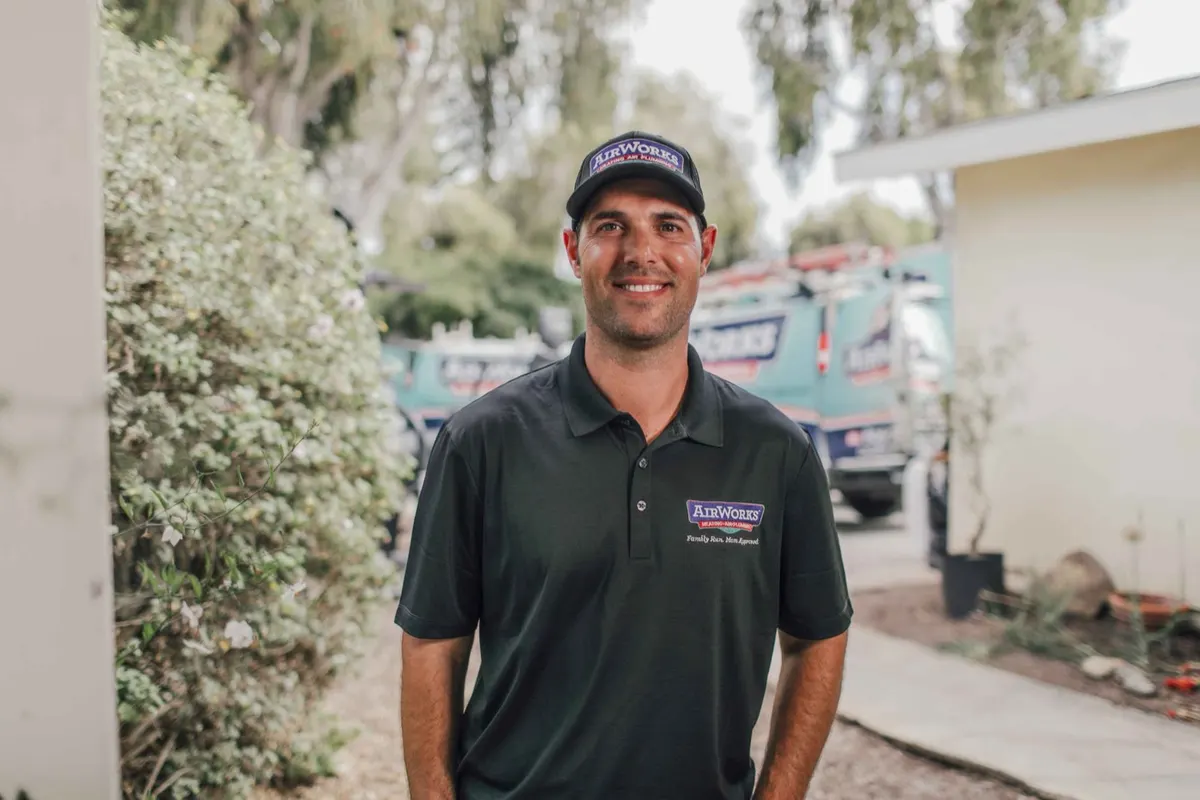
Kevin Allen
Co-Founder & Service Lead
Co-founded AirWorks in 2010 and has worked in Ventura County HVAC since 2002. Leads the service and installation crews — and the fix-what's-actually-broken ethic the company was built on.
Need Help?
Contact us today to discuss your needs. Our team is ready to help.
Related Articles
Options Comparisons for Homeowners: Heat Pump vs. Gas Furnace
Read Options Comparisons for Homeowners: Heat Pump vs. Gas FurnaceWhy Is Your Air Conditioner Hissing When Off? Causes and Diagnostics
Read Why Is Your Air Conditioner Hissing When Off? Causes and DiagnosticsHeat Pump vs. Gas Furnace: Technical Options Comparisons for Homeowners
Read Heat Pump vs. Gas Furnace: Technical Options Comparisons for HomeownersReady to Get Started?
Whether you need a repair, maintenance, or a new installation, our expert team is here to help.