
In-Depth Guide to Mini Split vs Central AC Cost Comparison
Kevin Allen
Co-Founder & Service Lead

Compare mini split vs central ac cost comparison to find the most efficient cooling solution for your home.
I'm trying to decide between a mini split and central AC for my Ventura County home. Which system offers the best long-term value?
The mini split vs central AC comparison is one of the most important decisions you'll face when upgrading your home's cooling system — and the answer is rarely one-size-fits-all. Here's a quick breakdown to help you find the right direction before diving deeper:
Quick Answer: Mini Split vs Central AC — Which Fits Your Home Best?
| Situation | Better Choice | Why |
|---|---|---|
| Home has no existing ductwork | Mini split | Avoids complex duct installation |
| Home has newer ducts in good condition | Central AC | Lower upfront investment per square foot |
| Cooling a single room or addition | Mini split | More targeted and efficient |
| Whole-home cooling with good ducts | Central AC | Most practical upfront option |
| Replacing both AC and furnace | Mini split | One system handles heating and cooling |
| Older or historic home | Mini split | No structural modifications needed |
The single biggest factor in this decision is simple: do you already have ductwork, and is it in good shape?
If your home has no ducts — or ducts that are leaky, aging, or poorly insulated — a ductless mini split system sidesteps a complex retrofit entirely. Central AC, on the other hand, is often the more straightforward path when serviceable ductwork already exists. Beyond the upfront investment, the comparison extends to energy efficiency, long-term operation, installation complexity, and how each system fits your specific home layout and comfort goals.
This is exactly the kind of decision that deserves a clear, honest look at all the variables — not just the lowest bid.
Our team at AirWorks has walked hundreds of Ventura County families through this decision. In this guide, we’ll walk you through everything you need to make a confident, informed decision.
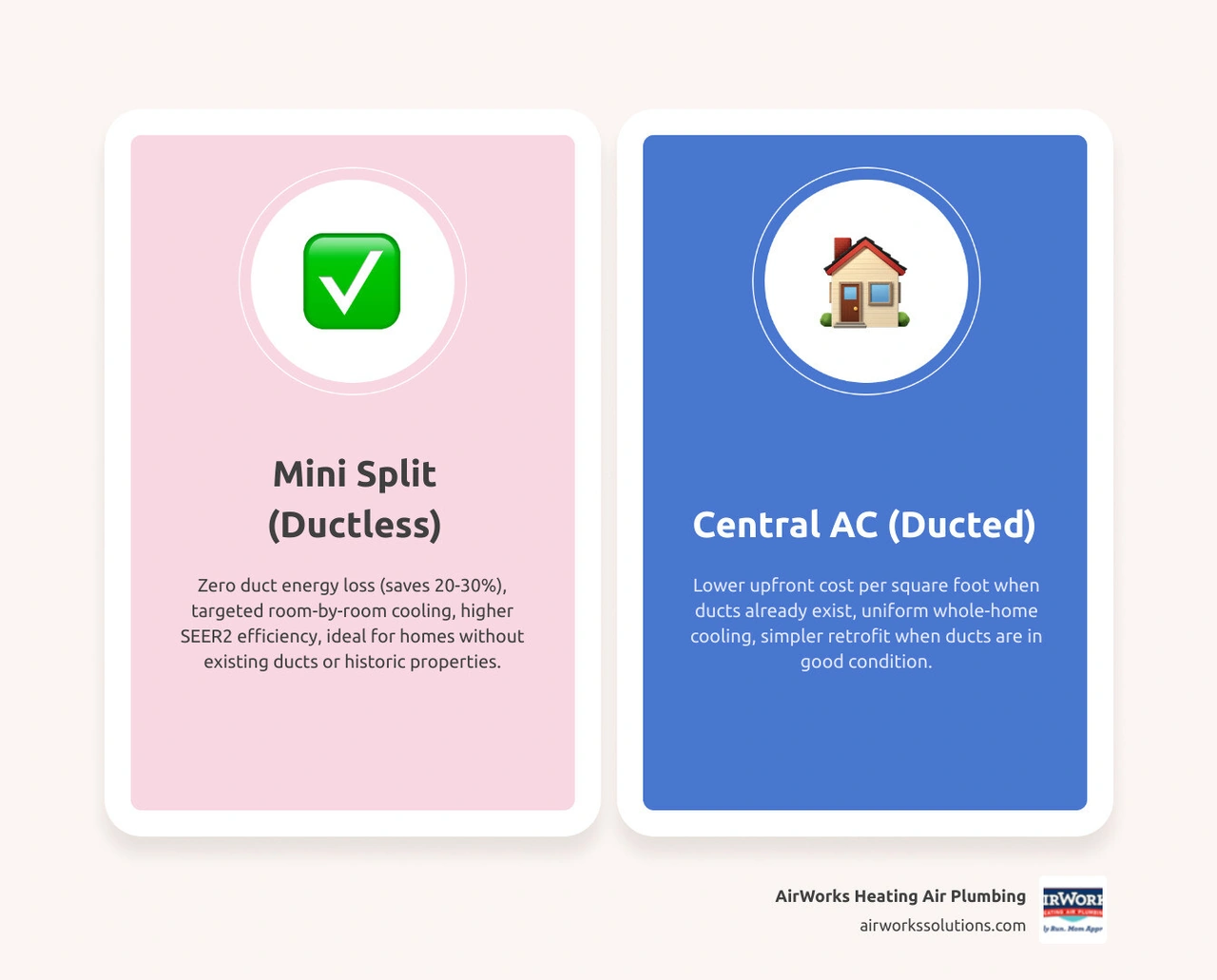
Quick mini split vs central AC comparison definitions:
- central AC vs ductless mini split comparison
- central air vs mini split for older homes
- is a mini split better than central air
Analyzing the Mini Split vs Central AC Comparison

When we sit down with families in Sacramento or Ventura County to discuss a new air conditioner, the conversation almost always starts with the upfront investment. It is easy to look at the equipment alone, but the real-world investment is shaped by several hidden layers: installation complexity, your home's layout, and the existing infrastructure.
Central AC has been the traditional standard for decades. It uses a single, high-powered outdoor condenser paired with an indoor evaporator coil (often sitting on top of your furnace) to push conditioned air through a network of hidden ducts. If your home already has a functional ducted system, replacing an old central AC unit is relatively straightforward.
Ductless mini splits, however, take a decentralized approach. Instead of one massive unit, a mini split system pairs an outdoor compressor with one or more compact indoor air handlers mounted directly on the walls or ceilings of specific rooms. To help visualize how these components work together to deliver targeted comfort, you can read more about how these units operate in our guide to Mini Split Systems Explained.
Because mini splits do not require ducts, the labor and materials are distributed differently. While central AC relies heavily on sheet metal work and airflow balancing across the entire house, mini split installations focus on electrical connections, mounting individual air handlers, and running thin refrigerant lines through small, non-invasive wall penetrations.
How Existing Ductwork Impacts the Mini Split vs Central AC Comparison
The presence and condition of your ductwork is the ultimate fork in the road.
If you live in an older home in Sacramento's Land Park or Midtown neighborhoods that relies on wall heaters or radiant floor systems, you likely have no ductwork at all. In this scenario, choosing central AC means you are not just buying an air conditioner; you are buying a major construction project. Retrofitting a home with new ducts requires opening up walls, lowering ceilings, sacrificing closet space, and paying for extensive drywall repairs. The labor and structural modifications required for a complete duct retrofit can quickly increase the scope of the project.
For a deeper dive into what this process looks like and how to prepare your home, check out our Ductless System Installation Complete Guide.
Even if you already have ductwork, it may not be in "good" condition. Older ducts often suffer from broken seals, collapsed sections, and poor insulation. If we inspect your attic and find that your ductwork is past its prime, you will face a choice: pay to completely replace the ductwork alongside a new central AC unit, or bypass the ducts entirely by switching to a ductless system.
Single-Zone vs. Multi-Zone Configuration Requirements
Another major variable in the mini split vs central AC comparison is how many rooms you actually need to cool.
Mini split systems are highly modular. If you only need to cool a single room — such as a newly built sunroom, a converted garage, or a stubborn upstairs master bedroom — a single-zone mini split is incredibly efficient. It requires just one indoor air handler and one small outdoor compressor, making the installation quick and minimally invasive.
However, if you want to cool a large, multi-story home, you will need a multi-zone configuration. This involves connecting multiple indoor air handlers (up to eight in some residential setups) to a single, larger outdoor compressor. Each indoor unit requires its own refrigerant line set, drain line, and electrical connections. As you add more zones to cover every bedroom, living area, and kitchen, the equipment and labor requirements scale up.
To understand how to size and plan these layouts for your home, our Ductless Mini Split Complete Guide covers everything from zone planning to choosing the right style of air handler.
Energy Efficiency and Long-Term Operation
While upfront installation is a major factor, the energy you use after the installation is what truly impacts your household budget over the next 15 to 20 years. This is where the efficiency differences between the two systems become crystal clear.
| Feature | Ductless Mini Split Systems | Traditional Central AC Systems |
|---|---|---|
| Average SEER2 Ratings | Up to 35+ SEER2 | Typically 14 to 26 SEER2 |
| Compressor Technology | Inverter-driven (variable-speed) | Single-stage or two-stage (on/off) |
| Duct Energy Loss | 0% (Ductless design) | 20% to 30% loss through leaks and attic heat |
| Zoning Capability | Built-in by default (room-by-room) | Requires complex motorized dampers |
| Average Lifespan | 15 to 20+ years | 12 to 15 years |
Long-Term Savings: A 10-Year Mini Split vs Central AC Comparison
The magic behind the efficiency of modern mini splits lies in inverter technology.
Traditional central AC systems often operate like a standard light switch: they are either 100% on or completely off. When your home warms up, the central AC kicks on at full blast, gulps down a massive amount of electricity, cools the house down, and shuts off. This constant cycling creates temperature swings and places heavy stress on the system's components.
Inverter-driven mini splits operate more like a dimmer switch. The compressor runs continuously, adjusting its speed incrementally to match the exact cooling needs of the room. By running at lower, steadier speeds, mini splits eliminate the power spikes associated with starting up.
Over a 10-year period, this variable-speed performance, combined with the ability to turn off cooling in unoccupied rooms, can lead to a 30% to 40% reduction in your monthly cooling energy usage. In hot summer regions like Citrus Heights or Simi Valley, those monthly savings compound into a massive financial advantage over the lifespan of the system. To keep these high-efficiency systems running at peak performance, regular professional care is essential. Homeowners in coastal areas can learn more about specialized upkeep through our Mini Split Service Oxnard page.
Eliminating Duct Loss and Thermal Bypass
The U.S. Department of Energy and the EPA's Energy Star program point out a harsh reality for ducted systems: most homes lose 20% to 30% of their conditioned air through duct leaks and poor insulation.
Think of it this way: if your monthly cooling bill is high, you could be throwing a significant portion of that energy directly into your attic or crawlspace. When ducts run through a scorching-hot attic, the cool air inside the ducts absorbs that heat before it ever reaches your living room. This is known as thermal bypass.
Because mini splits do not use ducts, they have zero duct loss. The cooled air is delivered directly into your living space, ensuring that every watt of electricity you pay for goes toward keeping your family comfortable. For residents dealing with the unique coastal humidity and heat of Ventura County, we offer specialized ductless options detailed on our Mini Split AC Oxnard page.
Practical Scenarios: When to Choose Ductless vs. Central AC
Because every home has a unique architectural layout and family dynamic, the right choice often comes down to practical everyday scenarios.
When Ductless Mini Splits Offer the Best Value
Ductless mini splits are the undisputed champions in several common situations:
- Historic Homes and Architectural Preservation: If you own a historic home in Sacramento or Ventura, the last thing you want to do is cut holes in plaster walls or lower beautiful, historic ceilings to hide ductwork. Mini splits preserve the structural and architectural integrity of your home, requiring only a tiny three-inch hole through an exterior wall to connect the indoor and outdoor units.
- Garage Conversions and ADUs: Turning a garage into a home office, gym, or Accessory Dwelling Unit (ADU)? Extending your existing central AC ductwork to these spaces is highly complex and often overtaxes your existing system. A single-zone mini split provides independent, highly efficient climate control without unbalancing your main house.
- Nuisance Rooms and "Hot Upstairs" Syndrome: Many two-story homes in Elk Grove or Folsom suffer from uneven temperatures, where the upstairs bedrooms stay several degrees warmer than the downstairs living room. Adding a mini split to the upstairs master bedroom solves this comfort gap instantly, allowing you to sleep in cool comfort without freezing the rest of the house.
If you live in Ventura County and are considering targeted zoning for your home, you can explore our local services at Ductless Mini Split Installation Thousand Oaks.
When Central AC Remains the Logical Choice
Despite the incredible efficiency of mini splits, traditional central AC is still the most practical and logical choice for many homeowners:
- Existing Ducts in Excellent Condition: If your home was built in the last 15 to 20 years and your ductwork is clean, tight, and well-insulated, upgrading to a high-efficiency central AC system is highly efficient. You will get reliable, whole-house cooling with a straightforward upfront installation than a whole-home, multi-zone mini split.
- Aesthetics and Invisible Comfort: Some homeowners simply prefer not to have visible indoor units mounted on their walls. Central AC is completely invisible, distributing air through discreet grilles that blend seamlessly into your ceilings or floors.
- Open-Concept Layouts: Central AC excels at volume cooling — moving large amounts of air evenly across wide-open, open-concept floor plans where independent room zoning isn't necessary.
If your existing central system has reached the end of its lifespan and you are weighing your replacement options, our team can help you evaluate your system through our Mini Split Replacement Ventura services.
Installation Complexity, Maintenance, and Lifespan
The physical process of installing these systems looks very different, and that directly impacts how much disruption you will experience in your daily life.
A central AC replacement can usually be completed in a single day if the existing ductwork is reusable. Our technicians simply swap out the old indoor coil and outdoor condenser, charge the system, and test the airflow.
Installing a multi-zone mini split system is a more detailed, multi-day process. We must carefully mount each indoor air handler, run individual refrigerant line sets through exterior walls, protect those lines with durable covers (known as line-hide), and establish communication wiring between each indoor zone and the outdoor compressor. For homeowners in the state capital, we provide comprehensive installation support detailed on our Mini Split Installation Sacramento page.
Maintenance and System Longevity
To protect your investment, both systems require regular care, but the homeowner's responsibilities differ:
- Central AC Maintenance: Typically requires changing a single central air filter every one to three months and scheduling an annual professional tune-up to clean the outdoor coils and check refrigerant levels.
- Mini Split Maintenance: Because mini splits pull air directly from the room they are in, their built-in filters are smaller and catch dust quickly. You will need to pop open the front panel of each indoor unit and rinse the reusable filters under a tap every two to four weeks. Additionally, because the blower wheels inside the wall units are prone to dust buildup, professional deep cleaning of the indoor heads is recommended every one to two years.
In terms of lifespan, central AC systems typically last 12 to 15 years. Mini splits, thanks to their inverter-driven compressors that suffer less mechanical stress from constant on/off cycling, commonly last 15 to 20+ years when properly maintained.
Federal Tax Credits and Financial Incentives
In June 2026, the financial math of upgrading your HVAC system is heavily influenced by federal and state incentives. Under the Energy Efficient Home Improvement Credit (Section 25C) of the Inflation Reduction Act, homeowners can claim substantial tax credits for qualifying high-efficiency upgrades.
Because mini splits are classified as high-efficiency heat pumps (which handle both heating and cooling), they qualify for the highest tier of federal tax incentives. Homeowners can claim a substantial federal tax credit for qualifying heat pump installations.
Standard central AC systems, by comparison, qualify for a lower tax credit tier.
Additionally, local utilities across California — including SMUD in Southern California Edison in Ventura County — offer localized rebates for transitioning to high-efficiency heat pump technology. When you stack these local utility rebates on top of the federal tax credits, the upfront investment gap between a multi-zone mini split and a traditional central AC system narrows significantly.
Frequently Asked Questions about Cooling Systems
Are mini splits quieter than central AC systems?
Yes, mini splits are the undisputed champions of quiet operation. The indoor air handlers of a mini split typically operate between 19 and 26 decibels — which is literally quieter than a whisper in a library. Because the noisy compressor is located entirely outdoors, all you hear inside is a gentle, almost imperceptible hum of moving air. Central AC systems, by contrast, typically operate between 40 and 60 decibels indoor, with a noticeable "whoosh" of air rushing through the metal ducts and an audible thump when the system cycles on.
Can a mini split system provide both heating and cooling?
Absolutely. Most modern mini splits are heat pumps, meaning they use a reversing valve to change the flow of refrigerant. In the summer, they absorb heat from inside your home and dump it outdoors. In the winter, they reverse this process, extracting ambient heat from the outdoor air (even in cold weather) and transferring it indoors to warm your home. This dual functionality allows a mini split system to replace both your old air conditioner and an aging furnace, giving you year-round comfort from a single system.
How do these systems impact indoor air quality?
Both systems play a vital role in managing humidity and filtering air, but they do so differently. Central AC allows you to integrate heavy-duty, whole-home air quality accessories directly into your ductwork, such as high-MERV media filters, UV air purifiers, and whole-house dehumidifiers. Mini splits, on the other hand, filter air locally in each room. While their washable filters are excellent at trapping dust and pet dander, they require more frequent cleaning to maintain optimal airflow and prevent dust buildup on the internal blower wheels.
Conclusion
At AirWorks Heating Air Plumbing, we believe that a truly comfortable home is built on honest, reliable, and personalized solutions. Whether you choose the invisible, whole-house coverage of a traditional central AC or the ultra-efficient, zoned comfort of a ductless mini split, our goal is to help you find the perfect fit for your family’s lifestyle and comfort needs.
Serving communities from Sacramento and Elk Grove down to Thousand Oaks and Ventura, our team brings over a decade of hands-on expertise to every home we visit. If you want to maximize the performance and extend the lifespan of your current ductless setup, don't wait for a breakdown — Schedule professional maintenance today with our trusted team.

About the Author
Kevin Allen
Co-Founder & Service Lead
Co-founded AirWorks in 2010 and has worked in Ventura County HVAC since 2002. Leads the service and installation crews — and the fix-what's-actually-broken ethic the company was built on.
Need Help?
Contact us today to discuss your needs. Our team is ready to help.
Related Articles
Options Comparisons for Homeowners: Heat Pump vs. Gas Furnace
Read Options Comparisons for Homeowners: Heat Pump vs. Gas FurnaceWhy Is Your Air Conditioner Hissing When Off? Causes and Diagnostics
Read Why Is Your Air Conditioner Hissing When Off? Causes and DiagnosticsHeat Pump vs. Gas Furnace: Technical Options Comparisons for Homeowners
Read Heat Pump vs. Gas Furnace: Technical Options Comparisons for HomeownersReady to Get Started?
Whether you need a repair, maintenance, or a new installation, our expert team is here to help.