In-Depth Guide to Mini Split vs Central Air
Kevin Allen
Co-Founder & Service Lead

Is a mini split better than central air? Discover zoned comfort, energy savings, and installation tips for your home.
I need to upgrade my home cooling in Ventura. Is a ductless mini-split better than central AC?
Is a mini split better than central air conditioning? The short answer: it depends on your home. Neither system wins in every situation. Here's a quick breakdown to help you decide:
| Factor | Mini-Split | Central AC |
|---|---|---|
| Best for | Homes without ductwork, additions, zoned rooms | Whole-home cooling with existing ductwork |
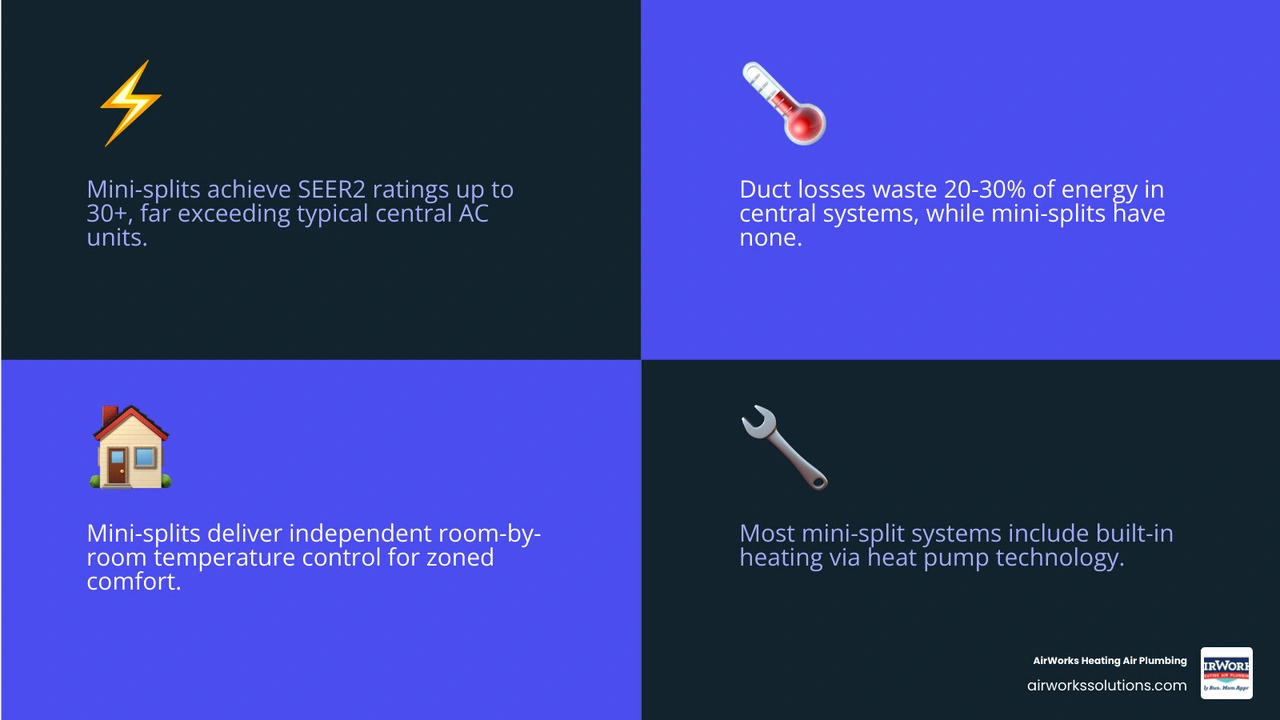
| Energy efficiency | Higher (SEER2 up to 30+) | Moderate (SEER2 typically 14–22) |
| Duct energy loss | None | 20–30% lost through ducts |
| Installation invasiveness | Minimal — small wall penetration | Significant if new ductwork needed |
| Heating included | Yes, most mini-splits are heat pumps | No — requires separate furnace |
| Zone control | Built-in, room by room | Limited without add-ons |
| Aesthetics | Visible wall-mounted indoor units | Hidden ducts and vents |
| Maintenance | Wash filters monthly | Replace filters every 1–3 months |
The truth is, many homeowners in Ventura County don't need to choose one over the other entirely. Some homes benefit from central AC for whole-home coverage and a mini-split for a problem room or addition. Others — especially older homes without existing ductwork — find that going fully ductless is the smarter, more efficient move.
In this guide, we'll walk through every major factor — efficiency, installation, comfort, maintenance, and more — so you can make a confident decision for your specific home.
I’m Kevin Allen. I co-founded AirWorks in 2010 and I run our service and installation crews. Whether you’re replacing an aging system or solving a stubborn comfort problem, this guide will give you the honest, straightforward answers you deserve.
Is a mini split better than central air terms to remember:
Understanding the Core Differences: Mini-Split vs. Central AC
To truly evaluate whether a ductless system or a traditional ducted setup is right for your home, it helps to look under the hood. While both systems are designed to keep you cool during those blistering California summer afternoons, they go about heat transfer and air distribution in entirely different ways.
Traditional central AC is a centralized powerhouse. It relies on a single, large indoor evaporator coil (usually tucked away in a closet, attic, or garage) paired with a noisy outdoor condenser. The system cools the air in one central location and then uses a powerful blower fan to push that conditioned air through a sprawling network of metal or flexible ducts running behind your walls and ceilings.
Ductless mini-splits, on the other hand, take a decentralized approach. Instead of forcing air through a massive maze of ductwork, they deliver comfort directly to the individual rooms where they are installed. A mini-split system consists of a sleek outdoor compressor connected to one or more compact indoor air handlers. These indoor units are mounted directly on your walls, ceilings, or even near the floor.
Let's look at how these differences play out in real-world performance:
- Heat Transfer and Air Distribution: Central AC draws air from a central return vent, cools it, and forces it back out. If a bedroom door is closed, or if the duct run is incredibly long, you end up with uneven temperatures. Mini-splits completely bypass this issue. They pull air directly from the room they are in, cool it instantly over localized coils, and whisper-quietly release it right back into the same space.
- Compressor Technology: Traditional central AC systems are often single-stage or two-stage. They operate much like a standard light switch—either running at 100% capacity or completely turned off. Mini-splits utilize advanced inverter-driven variable-speed compressors. Think of this like a dimmer switch. The compressor modulates its speed continuously, running at ultra-low, highly efficient speeds to maintain a perfectly steady temperature without constant on-and-off cycling.
If you want to explore how these individual units operate and the styles available for your home, check out our dedicated Ductless Mini Split Services page.
| Feature | Ductless Mini-Split | Traditional Central AC |
|---|---|---|
| Air Delivery | Directly into the room via localized air handlers | Pushed through hidden ducts and ceiling/floor registers |
| Duct Requirements | None (requires only a small 3-inch wall hole) | Requires extensive, sealed ductwork throughout the home |
| Compressor Type | Variable-speed inverter (modulates constantly) | Typically single-stage or two-stage (cycles on and off) |
| Temperature Control | Independent thermostats for every individual zone | Single central thermostat controlling the entire house |
| Redundancy | High (if one indoor head fails, others keep working) | Low (if the central system fails, the whole house loses cooling) |
Is a Mini Split Better Than Central Air for Energy Efficiency?
When we talk about energy efficiency in May 2026, the technology gap between these two systems has never been wider. Air conditioning accounts for roughly 19% of all residential electricity consumption in the United States, totaling a massive 254 billion kilowatt-hours annually. With energy rates in California continuing to climb, choosing the most efficient system isn't just an environmental choice—it's a monthly budget priority.
So, is a mini split better than central air when it comes to keeping your electric bills low? Absolutely.
The secret to the mini-split’s superior efficiency lies in two major advantages: the elimination of ductwork and the use of smart inverter technology.
According to the U.S. Department of Energy and the Environmental Protection Agency, the average home with a central AC system loses 20% to 30% of its conditioned air through leaks, cracks, and poor insulation in the ductwork. If your ducts run through a scorching hot attic in Thousand Oaks or Sacramento, the cool air inside those ducts absorbs heat before it ever reaches your living room. It’s the thermal equivalent of buying a gallon of milk and watching a quarter of it leak out of the carton on your drive home. Because mini-splits are entirely ductless, they suffer exactly 0% duct loss. Every single bit of cooling you pay for is delivered straight into your living space.
Additionally, the SEER2 (Seasonal Energy Efficiency Ratio 2) ratings speak for themselves. Standard central AC systems typically offer SEER2 ratings ranging from 14 to 22. Premium ductless mini-split systems, however, easily achieve SEER2 ratings of 20 to 30+, with some ultra-efficient models soaring all the way up to 42 SEER2.
Because the inverter-driven compressor in a mini-split can run at a mere fraction of its maximum capacity to maintain your set temperature, it avoids the massive electrical spikes associated with central AC units starting up over and over again. To learn more about how this efficiency translates to cooling your entire property, read our article: Are Mini Splits Good for Whole House Cooling?.
Comparing Installation and Upfront Considerations
The layout and age of your home will play a massive role in determining which system is the most practical choice.
If your home already has a robust, well-maintained network of ducts from an older central system, replacing it with a modern, high-efficiency central AC is often a highly straightforward process. However, if your ductwork is deteriorating, leaky, or completely non-existent, the installation math changes dramatically.
Installing new ductwork in an existing home is a major construction project. It requires cutting through drywall, sacrificing closet space, and running ducting through tight attic spaces or crawlspaces. This process can add significant expense on top of the standard equipment and installation charges. For older historic homes—such as the beautiful mid-century properties in Ventura or historic bungalows in Sacramento—adding ducts can permanently damage the architectural integrity of the home.
In contrast, a mini-split installation is remarkably non-invasive. To connect the indoor air handler to the outdoor compressor, our technicians only need to drill a small, three-inch hole through the exterior wall to run the copper refrigerant lines, electrical wiring, and condensate drain line. A single-zone mini-split system can easily be installed in just a few hours with minimal disruption to your daily routine.
For a real-world look at how we handle these clean, non-invasive installations, take a look at our case study on a Complete Mini Split Installation in Ventura.

Mini-splits are also the undisputed champions for:
- Room Additions: If you are adding a new sunroom, a mother-in-law suite, or converting a garage in Simi Valley, your existing central AC likely doesn't have the spare capacity to cool the extra square footage. Running new ducts to these spaces is often impractical. A single-zone mini-split provides dedicated comfort without overworking your main system.
- Older Homes: Properties built before the advent of residential air conditioning often rely on wall heaters or radiators. Mini-splits allow these homes to enjoy whisper-quiet, modern cooling without the need for invasive renovations.
Zoned Comfort vs. Whole-Home Consistency
One of the most common complaints we hear from homeowners is the "thermostat wars." The upstairs bedrooms are sweltering, the downstairs living room feels like an icebox, and family members are constantly sneaking over to adjust the thermostat.
Traditional central AC systems treat your entire house as a single, massive zone. The system runs until the temperature right next to the central thermostat matches your setting—completely ignoring the fact that your west-facing master bedroom is taking the brunt of the afternoon sun. While you can install motorized dampers to create zones in a central system, doing so adds mechanical complexity and rarely matches the precision of a ductless setup.
Mini-splits solve this problem through built-in, room-by-room zoning. Each indoor air handler operates on its own independent thermostat. This means you can keep your home office at a crisp 71 degrees while you work, set the guest room to a comfortable 75 degrees, and turn the unit in the living room completely off when nobody is using it. This localized control not only maximizes personal comfort but also slashes your utility bills by ensuring you never waste energy cooling unoccupied spaces.
To discover which areas of your home can benefit the most from this targeted approach, check out our guide on the Best Rooms for a Mini Split System.
When is a mini split better than central air for zoning?
A mini-split is almost always the superior choice for zoning when you have multi-story layouts, finished attics, converted basements, or rooms with wildly different heating and cooling demands.
With a multi-zone mini-split system, a single outdoor compressor can power up to eight independent indoor air handlers. This allows you to customize the climate in every corner of your home, catering to the individual preferences of your family members while capitalizing on the energy savings of occupancy-based cooling.
When is a mini split better than central air for heating?
Many homeowners don't realize that most modern mini-splits are actually heat pumps. Rather than burning natural gas or using inefficient electric resistance coils to generate heat, heat pumps simply reverse the cooling process. They extract ambient heat from the outdoor air—even when temperatures drop below freezing—and transfer it indoors.
Heat pumps are incredibly efficient, performing at up to 300% to 400% efficiency because they move heat rather than create it. This can significantly lower annual heating bills compared to traditional electric baseboard heaters or older furnaces. If you are debating whether to replace your entire HVAC setup, read our comprehensive breakdown on Heat Pumps vs. Furnaces: Which Is Best for Your Home?.
Long-Term Maintenance, Lifespan, and Air Quality
Investing in a new comfort system is a long-term commitment. Understanding the ongoing maintenance, expected lifespan, and indoor air quality impact of each system will help you protect your investment.
Air Quality and Filtration
Central AC systems generally have the upper hand when it comes to robust, whole-home air filtration. Because central systems pull air from throughout the entire house and pass it through a single, thick, pleated MERV-rated filter, they are highly effective at capturing airborne dust, pet dander, and pollen. You can also easily integrate whole-home air purification systems, UV lights, and humidifiers directly into your central ductwork.
Mini-splits utilize individual washable mesh filters inside each indoor unit. These are fantastic for trapping larger dust particles, but because they rely on passive, low-static-pressure airflow, they don't offer the same high-MERV filtration power as a central system. However, they do prevent the accumulation of dust, mold, and allergens that can naturally build up inside old, uncleaned ductwork over time.
Maintenance Requirements
Both systems require regular attention to perform at peak efficiency, but the tasks look a little different:
- Central AC Maintenance: Requires replacing the central air filter every 1 to 3 months. Additionally, the ductwork should be professionally inspected for leaks and cleaned every 5 to 7 years to prevent dust buildup and maintain airflow.
- Mini-Split Maintenance: Requires a bit more hands-on homeowner care. The mesh filters inside each indoor air handler should be popped out and rinsed under a faucet every 2 to 4 weeks, especially if you have pets. Because these units are located directly inside your living spaces, keeping the coils and blowers clean is vital to prevent dust buildup and maintain system efficiency.
To ensure your system is properly sized to handle your home's unique heating and cooling loads without short-cycling, refer to our AC Unit Sizing Guide for Homeowners.
Frequently Asked Questions About Mini-Splits and Central AC
How long do mini-split systems last compared to central AC?
With proper maintenance, both mini-split and central AC systems have a typical lifespan of 15 to 20 years. However, premium mini-split systems can sometimes last up to 25 years because their variable-speed compressors experience far less wear and tear from constant on-and-off cycling compared to traditional central AC units. Keeping the filters clean and scheduling annual professional tune-ups are the most important factors in maximizing your system's lifespan.
Can a mini-split system cool an entire house?
Yes, a multi-zone mini-split system can absolutely cool an entire house. By connecting multiple indoor air handlers (such as wall-mounted units, floor consoles, or ceiling cassettes) to a single outdoor compressor, you can create a fully customized, whole-home cooling solution. This is an incredibly popular option for homes that lack existing ductwork or for homeowners looking to retire their old, leaky ducts for good.
Do mini-splits provide both heating and cooling?
Yes! Most modern residential mini-splits are heat pumps, meaning they offer highly efficient year-round comfort. They use a reversing valve to swap the flow of refrigerant, allowing the system to keep you cool all summer and warm and cozy all winter.
Conclusion
At the end of the day, deciding whether is a mini split better than central air comes down to your home’s layout, your comfort goals, and your existing infrastructure. If your home has functional ductwork in great condition, upgrading to a high-efficiency central AC system is a reliable and comfortable choice. But if you have an older home without ducts, are building a new addition, or are tired of fighting over the thermostat, a ductless mini-split system offers unmatched efficiency and localized control.
At AirWorks Heating, Air & Plumbing, we’ve been delivering honest, customer-focused heating, plumbing, and cooling solutions to homeowners across Ventura County and the Sacramento area since 2010. Our experienced team can help you evaluate your home’s unique needs and design a personalized comfort system that keeps your family happy and your energy bills low.
If you already have a ductless system and want to keep it running at peak performance, or if you need professional help in the West Hills area, schedule your service today by visiting our Ductless Mini-Split Maintenance in West Hills, CA page. Let us help you find the perfect comfort solution for your home!

About the Author
Kevin Allen
Co-Founder & Service Lead
Co-founded AirWorks in 2010 and has worked in Ventura County HVAC since 2002. Leads the service and installation crews — and the fix-what's-actually-broken ethic the company was built on.
Need Help?
Contact us today to discuss your needs. Our team is ready to help.
Related Articles
Options Comparisons for Homeowners: Heat Pump vs. Gas Furnace
Read Options Comparisons for Homeowners: Heat Pump vs. Gas FurnaceWhy Is Your Air Conditioner Hissing When Off? Causes and Diagnostics
Read Why Is Your Air Conditioner Hissing When Off? Causes and DiagnosticsHeat Pump vs. Gas Furnace: Technical Options Comparisons for Homeowners
Read Heat Pump vs. Gas Furnace: Technical Options Comparisons for HomeownersReady to Get Started?
Whether you need a repair, maintenance, or a new installation, our expert team is here to help.