
How Often Does an AC Need Refrigerant? 2026 Guide
Kevin Allen
Co-Founder & Service Lead

ACs shouldn't use up refrigerant - needing more means a leak. See the 2026 guide to recharge frequency and costs. Call AirWorks at (805) 312-9539.
How Often Does an AC Need Refrigerant in Ventura County?
How often does an AC need refrigerant is one of the most common questions homeowners ask and the honest answer might surprise you: a properly working air conditioner should never need refrigerant added. Not once a year. Not every few years. Never unless there is a leak somewhere in the system.
Here is a quick answer:
| Situation | Does Your AC Need Refrigerant? |
|---|---|
| System is working normally | No refrigerant is sealed in a closed loop and never gets used up |
| AC is blowing warm air | Possibly could indicate a refrigerant leak |
| Ice on refrigerant lines or coils | Likely yes a common sign of low refrigerant due to a leak |
| Hissing or bubbling sounds near the unit | Yes this often points to an active refrigerant leak |
| System is older than 15 years | Possibly older systems are more prone to developing leaks |
Unlike gas in a car, refrigerant is not consumed during operation. It circulates continuously through a sealed copper coil system absorbing heat inside your home and releasing it outside over and over again. The refrigerant that came in your AC when it was installed should still be there years later, as long as no leak has developed.
If a technician tells you that you need refrigerant "topped off" as part of routine maintenance without diagnosing a leak first that is a red flag worth paying attention to.
For homeowners scheduling air conditioning service, AC repair, or AC maintenance in Ventura County, understanding this can help you make better decisions about your home comfort system.
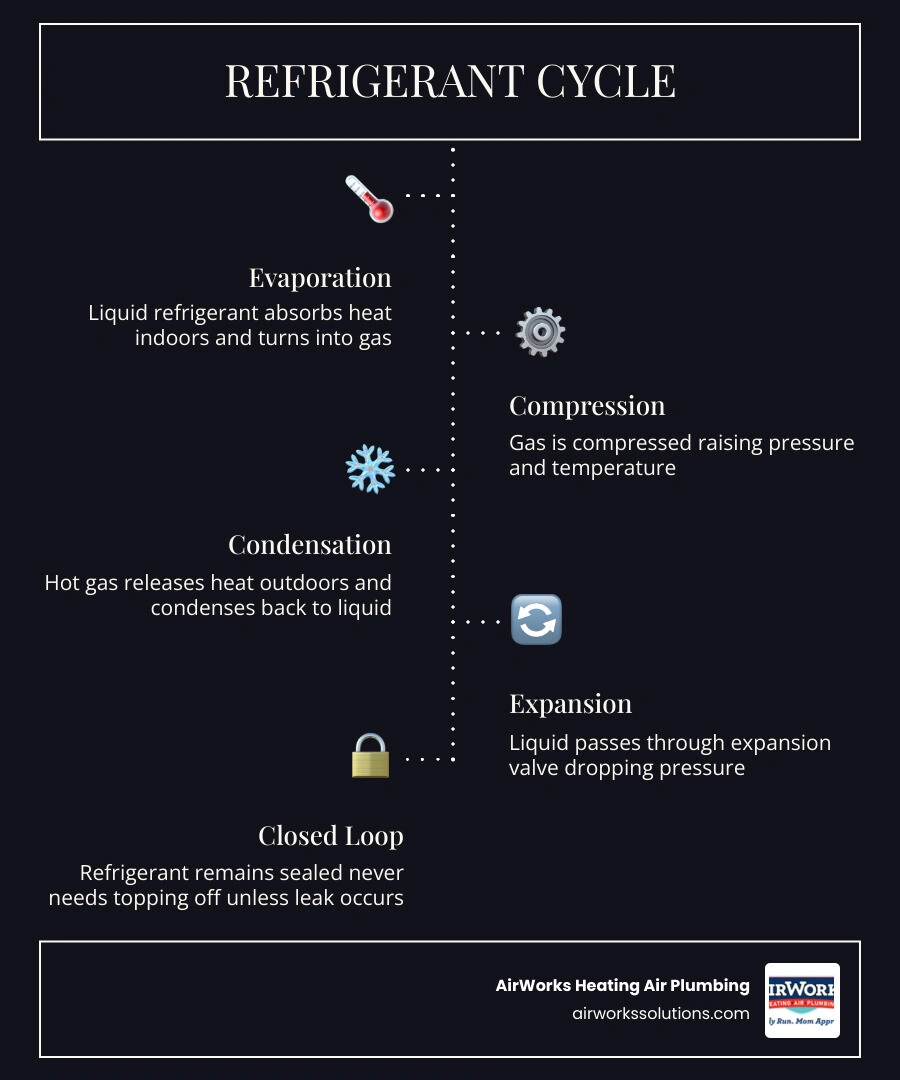
Terms related to how often does an AC need refrigerant:
The Truth About How Often an AC Needs Refrigerant
To understand why your air conditioner shouldn't need a "refill," we have to look at how the system is built. Your AC is a closed-loop system. Think of it like the circulatory system in your body or the cooling system in your refrigerator. The refrigerant stays inside a sealed circuit of copper coils and never leaves—unless there is a hole.
The process involves two main components: the evaporator coil (located inside your home) and the condenser coil (the unit outside). The refrigerant travels between these two points, changing from a liquid to a gas and back again. As it changes state, it absorbs heat from your indoor air and carries it outside to be released. Because it is a sealed circuit, the amount of refrigerant should stay exactly the same for the entire life of the unit.
We often perform an HVAC System Check for our neighbors in Ventura County, and the most important thing we verify is that these levels are stable. If the levels are low, it is a 100% guarantee that there is a leak or that the system was installed incorrectly from day one.
As of May 2026, the industry is moving through several transitions regarding the types of refrigerant used. Here is a quick look at the properties of the most common types:
| Refrigerant Type | Common Name | Status in 2026 | Environmental Impact |
|---|---|---|---|
| R-22 | Freon | Phased out (Pre-2010 systems) | High ozone depletion |
| R-410A | Puron | Being phased out | High global warming potential |
| R-454B / R-32 | Next-Gen | Current standard for new installs | Lower global warming potential |
Identifying a Refrigerant Leak in Your Home
If your system is low on refrigerant, the culprit is almost always a leak. These leaks don't just happen for no reason; they are usually caused by a few specific factors.
- Corrosion: Over time, the copper coils can develop tiny "pinhole" leaks due to formicary corrosion. This is often caused by the interaction of copper with common household chemicals or even just the moisture in our California air.
- Vibration Stress: Your AC has moving parts, specifically the compressor and the fan. Constant vibration over years of service can cause the copper lines to rub against other components or weaken the joints where the pipes are welded together.
- Aging Components: As a system reaches the 12-to-14-year mark, the seals and valves naturally begin to degrade.
When we provide an AC Repair Calabasas Complete Guide, we emphasize that catching these leaks early is the key to preventing a total system breakdown.
Warning Signs and How Often an AC Needs Refrigerant
Since the answer to how often does an AC need refrigerant should be "never," any sign that you are low is a sign of trouble. You don't need a pressure gauge to tell if something is wrong; your home will tell you.
- The Air Isn't Cold: If the air coming out of your vents feels lukewarm or just "room temperature," your refrigerant likely isn't at the level needed to absorb heat effectively.
- Frozen Coils: This seems counterintuitive. If the refrigerant is low, why is there ice? When refrigerant levels drop, the pressure in the evaporator coil drops too. This causes the coil to get much colder than it should, freezing the humidity in the air right onto the metal.
- High Energy Bills: When the system is low on refrigerant, it has to run much longer to reach the temperature set on your thermostat. If you notice your bills spiking in Oxnard or Simi Valley without a change in the weather, a leak could be the reason.
- Strange Noises: Why Is My Air Conditioning Making a Hissing Sound? is a question we answer frequently. A hissing sound usually indicates refrigerant gas escaping under high pressure. A bubbling sound might mean the leak is in a spot where the refrigerant is still in its liquid state.
Professional Inspections and How Often an AC Needs Refrigerant
If you suspect a leak, you shouldn't wait. Running an AC with low refrigerant can lead to a "slugged" compressor—essentially killing the heart of your AC system. When we arrive for a service call, we don't just add more gas and leave. We follow a strict diagnostic process.
First, we use electronic leak detectors. These are highly sensitive "sniffers" that can detect the presence of refrigerant molecules in the air around the coils. If the leak is too small for the sniffer, we may perform a nitrogen pressure test. We empty the system and fill it with high-pressure nitrogen. If the pressure drops on our gauges, we know there is a hole.
In some cases, we use UV dye testing. We add a special fluorescent dye to the system, let it circulate, and then return with a blacklight to see exactly where the "glow" is escaping. This is the only way to ensure that when we perform an Emergency HVAC Repair Camarillo Guide service, the fix is permanent.

Why You Must Repair Leaks Before Recharging
It might be tempting to just ask a technician to "top it off" every summer. However, this is a bad idea for three major reasons:
- It’s Illegal and Unethical: Under EPA Section 608 regulations, it is illegal to knowingly vent refrigerant into the atmosphere. While the law allows for adding refrigerant to most residential systems, simply refilling a known "gusher" of a leak without attempting a repair is harmful to the environment and a waste of your money.
- It Damages the Compressor: Refrigerant doesn't just cool your home; it also carries the oil that lubricates the compressor. When refrigerant leaks out, that oil isn't circulated properly. Running a system low on refrigerant is like running a car engine with only one quart of oil—it will eventually seize up.
- Efficiency Losses: A system that is even 10% low on refrigerant can see a massive drop in efficiency. You’ll end up paying far more in monthly electricity costs than the cost of a proper AC Repair in Camarillo, CA.
Risks of Running an AC with Low Refrigerant:
- Total compressor failure (the most expensive part to replace)
- Increased wear and tear on the fan motor
- Potential for water damage in your home as ice on the coils melts and overflows the drain pan
- Significant environmental damage from greenhouse gas emissions
Preventive Maintenance and System Longevity
The best way to ensure you never have to ask how often does an AC need refrigerant is to keep the system in peak condition. Regular maintenance is the "secret sauce" to a long-lasting HVAC system.
During a professional AC Maintenance in Ventura, CA visit, we check the "subcooling" and "superheat" levels. These are technical measurements that tell us exactly how the refrigerant is performing. By catching a tiny leak during a spring tune-up, we can often tighten a flare nut or replace a Schrader valve before you lose a significant amount of refrigerant.
Homeowners can help, too! Changing your air filters every 30 to 90 days prevents the system from working too hard, which reduces vibration stress on the lines. Also, keeping the outdoor unit clear of debris—like the leaves and dust we get in Citrus Heights and Elk Grove—ensures the condenser can breathe properly. If you haven't had your system checked this year, scheduling an AC Tune-Up in Oxnard, CA is the smartest move you can make for your home's comfort.
Repair vs. Replacement for Older Units
If you have an older system that uses R-22 refrigerant (usually units built before 2010), you are in a difficult spot. R-22 has been phased out completely. It is no longer manufactured or imported. The only supply left is "reclaimed" refrigerant from old systems that have been decommissioned.
Because the supply is so limited, the cost to recharge an R-22 system is astronomical. In many cases, if an R-22 system has a major leak in the evaporator coil, we recommend a full system replacement. Investing a large amount of money into a 15-year-old system that uses obsolete refrigerant is often "throwing good money after bad."
Modern systems using R-454B or R-32 are significantly more energy-efficient and better for the environment. If your system is approaching its 12th birthday and starts developing refrigerant issues, it might be time to look into AC Service in Westlake Village, CA to discuss replacement options. A new unit will not only be more reliable but will likely lower your summer cooling bills in Sacramento by 20% to 40%.
Frequently Asked Questions about AC Refrigerant
Does AC refrigerant ever evaporate or get used up?
No. Refrigerant is in a completely sealed, pressurized system. It does not evaporate into the air, and it does not "burn off" like oil in an old engine. If the level is low, it escaped through a hole or a loose fitting.
Is it safe to run my air conditioner if I suspect a leak?
It is not recommended. If the refrigerant is low, the compressor is likely running too hot and without enough lubrication. Turning the system off until a professional can inspect it is the best way to prevent a minor leak from becoming a total system replacement.
How can I tell which type of refrigerant my system uses?
You can usually find this information on the "data plate" on the side of your outdoor condenser unit. It will list the model number, serial number, and the "Refrigerant Type" (usually R-22, R-410A, or R-32). If the sticker has faded, an experienced technician can tell by the age of the unit and the type of fittings used.
Conclusion
At AirWorks Heating, Air & Plumbing, we believe in honest, customer-focused service. We’ve been serving the greater Ventura County areas since 2010, and our goal is always to provide reliable solutions that keep your family comfortable without breaking the bank.
Remember: if your system is healthy, you should never have to worry about how often does an AC need refrigerant. If you are noticing warm air, ice on your lines, or hissing sounds, don't wait for the system to fail completely. Whether you need a simple repair or a full Air Conditioning replacement, our team is here to help with expert knowledge and a commitment to doing the job right the first time.
Give us a call today to schedule your inspection and ensure your home stays cool all summer long!

About the Author
Kevin Allen
Co-Founder & Service Lead
Co-founded AirWorks in 2010 and has worked in Ventura County HVAC since 2002. Leads the service and installation crews — and the fix-what's-actually-broken ethic the company was built on.
Need Help?
Contact us today to discuss your needs. Our team is ready to help.
Related Articles
Options Comparisons for Homeowners: Heat Pump vs. Gas Furnace
Read Options Comparisons for Homeowners: Heat Pump vs. Gas FurnaceWhy Is Your Air Conditioner Hissing When Off? Causes and Diagnostics
Read Why Is Your Air Conditioner Hissing When Off? Causes and DiagnosticsHeat Pump vs. Gas Furnace: Technical Options Comparisons for Homeowners
Read Heat Pump vs. Gas Furnace: Technical Options Comparisons for HomeownersReady to Get Started?
Whether you need a repair, maintenance, or a new installation, our expert team is here to help.