Why Is My AC Running But Not Cooling? A Homeowner's Diagnostic Guide
Kevin Allen
Co-Founder & Service Lead

Facing the Frustration of an AC That Runs But Won't Cool
Your AC is running nonstop, but the house still feels warm. The indoor fan hums, air moves through the vents, yet the thermostat temperature continues to creep upward against the intense August late-summer heat. Leaning on our local service expertise and area tips can help you navigate this incredibly frustrating scenario. Here at AirWorks Solutions, Inc., our team knows exactly how it feels when you hear the equipment working but feel no relief. You face an immediate decision point: do you ignore the declining performance and hope the system limps through the rest of the season, or do you schedule a professional diagnostic right away?
Need help right away? Explore our air conditioning services or schedule an AC emergency repair to restore your home's comfort today.
While some airflow issues stem from simple, easily correctable causes, a system that operates continuously without actually lowering the indoor temperature is usually experiencing severe mechanical stress. The air conditioner is consuming massive amounts of electricity, but the heat transfer process has broken down. In our experience, timely intervention is the best way to prevent an uncomfortable afternoon from escalating into a total, catastrophic system failure.
Understanding End-of-Season AC Fatigue
When an air conditioner suddenly stops blowing cold air in late August, the culprit is often a phenomenon our technicians refer to as end-of-season AC fatigue. This occurs after months of heavy, continuous use. Your cooling system works incredibly hard from May through July, and by the time late summer arrives, the cumulative toll of that thermal stress begins to show.
In our years of serving Somis, we've noticed that components that performed adequately during the early summer months often reach their breaking point as the season drags on. Constant cycling—turning on and off repeatedly to combat the August late-summer heat—takes a physical toll on moving parts, electrical connections, and overall system efficiency.
The Mechanics of Thermal Stress:
- Electrical wear: Capacitors and contactors endure thousands of electrical surges throughout the summer. Over time, the constant flow of high voltage degrades these components, preventing them from signaling the compressor to start.
- Mechanical friction: Fan motors and blower assemblies rely on lubrication. After months of non-stop operation, that lubrication breaks down, causing motors to overheat and shut down prematurely.
- Vibration damage: The continuous vibration of the outdoor unit can slowly loosen electrical connections and chafe refrigerant lines, eventually leading to critical failures.
If you experience a sudden drop in cooling capacity late in the season, rest assured that our team sees this common, well-documented pattern every year. It is not a rare anomaly, but rather the predictable result of a machine being pushed to its limits for an extended period.
Safe Troubleshooting: Simple Checks Before Calling a Professional
Before you pick up the phone to call our team, there are a few safe, basic diagnostic steps you can take. These checks do not require any specialized tools, and they carry no risk of electrical shock or damage to the equipment. If you want to learn more about basic maintenance, reviewing DIY AC troubleshooting tips can help you rule out user error.
- Verify your thermostat settings. It sounds overly simple, but we always recommend checking the thermostat first. Ensure it is explicitly set to "Cool" and not just "Fan" or "Heat." Additionally, make sure the fan setting is on "Auto" rather than "On." If the fan is set to "On," the indoor blower will run 24/7, even when the outdoor compressor isn't actively cooling the air. This results in warm, unconditioned air circulating through your vents.
- Check the circuit breaker panel. Air conditioning systems have two separate power sources: one for the indoor air handler and one for the outdoor condenser. It is entirely possible for the outdoor unit's breaker to trip while the indoor fan continues to run. Open your electrical panel and look for a tripped breaker. If you find one, flip it completely to the "Off" position, then firmly back to "On." Do not do this more than once—if it trips again immediately, you have a serious electrical short.
- Inspect all indoor return and supply vents. Walk through your home and ensure that no furniture, heavy rugs, or curtains are blocking the vents. Central air conditioning relies on a precise balance of return air (pulled from the house) and supply air (pushed into the rooms). Closing too many vents in unused rooms disrupts this balance, increasing pressure inside the ductwork and severely restricting the system's ability to cool.
These are the only safe steps a homeowner should take. Opening access panels, testing high-voltage capacitors, or attaching gauges to refrigerant lines requires a specialized license, strict safety protocols, and professional training.

Airflow Restrictions and the Frozen Evaporator Coil Cycle
The Problem: You hear the system running continuously, but the air coming out of the vents is barely trickling out, and it feels room-temperature or even slightly warm. If you check the indoor unit, you might even see water pooling on the floor or ice forming on the copper lines.
The Cause: Our technicians frequently find that clogged air filters severely restrict airflow, leading to a cascade of performance issues. To understand why, you have to look at the science of the refrigeration cycle. Your air conditioner does not "create" cold air; it absorbs heat from inside your home and moves it outside. The indoor evaporator coil gets extremely cold during this process. It relies on a constant flow of warm, unconditioned indoor air blowing across it to absorb that heat.
When a dirty filter, a failing blower motor, or blocked vents restrict that airflow, the evaporator coil has no heat to absorb. As a result, the temperature of the coil drops below freezing. The natural humidity in your indoor air condenses onto the freezing metal and instantly turns to frost. Over a few hours of continuous running, that frost builds into a solid block of ice, completely encasing the coil.
The Solution: The ice block acts as an insulator, preventing any further heat transfer. The system will run endlessly, wasting electricity, while the house continues to heat up. If you suspect a frozen coil, turn the system off immediately at the thermostat. Turn the fan setting to "On" to help blow warm air over the ice and melt it. Do not attempt to scrape the ice off, as the copper coils are fragile and easily punctured. Once the system has fully thawed (which can take several hours) and you have replaced the air filter, you can try running it again. If it freezes a second time, you have a deeper mechanical issue.
Outdoor Condenser Stress in Dry, Dusty Climates
While the indoor unit absorbs heat, the outdoor unit—the condenser—is responsible for releasing that heat into the outside air. The outdoor unit features a large fan that pulls ambient air through hundreds of thin metal fins surrounding the condenser coil. For this heat transfer to work, those metal fins must be clean and clear of obstructions.
At AirWorks Solutions, Inc., we see this constantly: the warm, dry late-summer climate in Somis accelerates dust and debris buildup on these outdoor units. Throughout the summer, dry winds kick up agricultural dust, loose dirt, and yard debris. This material gets sucked directly into the condenser fins. Over several months, this creates a thick, insulating blanket of grime over the coils.
When the outdoor coil is insulated by dirt, the heat absorbed from your home cannot escape into the outside air. The refrigerant stays hot, and the system loses its ability to cool the house. Data from the U.S. Department of Energy (DOE) shows that dirty condenser coils can increase compressor energy consumption by up to 30 percent while slashing overall cooling capacity. The compressor has to work significantly harder, running at higher pressures and higher temperatures, which drastically shortens its lifespan.
To restore proper heat transfer efficiency, the outdoor unit requires a thorough, chemical cleaning. Scheduling a professional AC inspection ensures that the delicate aluminum fins are cleaned safely without being bent or crushed, allowing the system to breathe and release heat effectively once again.
Critical System Failures: When Diagnostics Require a Licensed Technician
The Problem: You have checked the filter, verified the thermostat, and ensured the breakers are on, but the system still runs without producing cold air. The issue has moved beyond basic airflow restrictions into the realm of mechanical failure.
The Cause: Several critical components can fail and cause this exact symptom. First, consider refrigerant leaks. Air conditioning systems operate on a closed loop; they do not "consume" or "burn up" refrigerant over time. If your system is low on refrigerant, it means there is a physical hole or crack in the copper lines or coils. Low refrigerant prevents the system from absorbing heat, causing it to run constantly while blowing warm air. A professional must locate the leak, repair the copper, and precisely recharge the system.
Second, the outdoor compressor may have failed. The indoor fan will still run and circulate air through the house, but if the outdoor compressor (the heart of the system that pumps the refrigerant) is dead, absolutely no cooling can occur. Finally, electrical component wear is a frequent culprit. Failing capacitors or pitted contactors can prevent the outdoor unit from initiating its cooling cycle, even while the indoor blower operates normally.
The Solution: These issues require specialized diagnostic tools and high-voltage training to resolve safely. Attempting DIY repairs on these components carries severe risks of electrical shock and can easily void your manufacturer's warranty. One homeowner in the area recently experienced an undetermined AC system issue that left their house uncomfortable. Rather than guessing at the problem, they called our team. An AirWorks Heating, Air & Plumbing technician thoroughly investigated the equipment, determined the complex root cause, and got the system back on track safely. If you are facing similar symptoms, it is time to call for emergency AC repair in Somis.
Signs It's Time to Stop Troubleshooting
- Hissing or bubbling noises: If you hear these sounds near the indoor unit or the outdoor refrigerant lines, it strongly indicates an active, pressurized refrigerant leak.
- Total outdoor silence: If the indoor fan is blowing but the large outdoor unit is completely silent and motionless, the cooling cycle cannot happen.
- Tripping breakers: If the circuit breaker trips immediately every time the AC attempts to start, the compressor is likely shorting out to the ground. Stop resetting the breaker to avoid an electrical fire.
The True Cost of Waiting Out the Summer
When faced with a struggling AC unit in late August, the temptation to simply endure sub-par cooling as the kids head back to school is strong. You might think that if the system is still blowing a little bit of cool air, it can survive until the temperatures drop in autumn. However, our team can tell you firsthand that this is a costly misconception.
Forcing a compromised system to run continuously accelerates wear on the most expensive components. If your system is low on refrigerant or struggling with a dirty coil, the compressor is running hotter and longer than it was designed to. What might start as a minor, easily fixable issue—like a failing capacitor or a small leak—can quickly snowball into a catastrophic compressor failure if the system is not shut down and repaired. Replacing a burned-out compressor is one of the most extensive repairs in the HVAC industry. (While federal tax credits may apply to qualifying heat pump installations if a full replacement is needed, preventing the breakdown in the first place is always our primary goal).
Furthermore, running an inefficient system 24/7 has a massive financial impact on your monthly utility bills. An air conditioner running non-stop at half capacity uses significantly more electricity than a healthy system running in normal, efficient cycles.
Working with certified experts means that professional inspections catch minor wear before it causes a total, costly system breakdown. Another local customer faced an undetermined problem with their AC system that kept it running without cooling. A technician from our crew promptly and competently determined the problem, fixing it on the spot and preventing further damage to the unit. Proactive diagnostics are always less disruptive—and less stressful—than dealing with an emergency breakdown during a late-season heatwave.
Protecting Your Home's Comfort Through the Rest of the Season
An air conditioner that runs continuously without actually cooling your home is sending a clear signal for help. It is not a minor quirk to ignore, but rather a symptom of mechanical stress, airflow restriction, or refrigerant loss. While checking your filter and thermostat are great first steps, continuing to run a struggling system will only compound the damage.
Professional diagnostics are the safest, most effective way to restore your home's comfort and protect your equipment from permanent failure. By relying on our local service expertise and area tips, you can ensure your cooling system finishes the season strong. Do not wait for a complete breakdown—reach out to AirWorks Solutions, Inc. for expert help and get your home back to a comfortable, safe temperature.
Frequently Asked Questions
Why is my AC running but not cooling the house?
When your AC runs without cooling, it usually means the system has lost its ability to transfer heat. Our technicians frequently trace this back to a clogged air filter restricting airflow, a dirty outdoor condenser coil trapping heat, or a refrigerant leak. The indoor fan continues to circulate air, but without the refrigeration cycle working properly, that air remains warm.
How do I fix an AC that is running but not cooling?
Start by checking the safest, most accessible components first. We recommend verifying that your thermostat is set to "Cool" and "Auto," replacing your indoor air filter if it is dirty, and ensuring all room vents are open. If these basic steps do not restore cold air, you must turn the system off and call a licensed technician to diagnose the mechanical or electrical failure.
Will the AC fan run if the compressor is bad?
Yes, the indoor blower fan operates independently of the outdoor compressor. If the compressor fails, the indoor fan will continue to pull air from your home and push it back through the vents. However, because the compressor is not pumping refrigerant to remove heat, the air blowing out of the vents will be room temperature.
How do you know if your AC compressor is broken?
A broken compressor often presents clear warning signs before failing completely. You might hear loud grinding, clanking, or hard-starting noises from the outdoor unit. Additionally, if the outdoor fan is spinning but the unit is unusually quiet and the air coming out of the top is cool instead of hot, it indicates to our team that the compressor is likely not engaging.
Can dusty late-summer conditions cause my AC to stop cooling?
Absolutely. In our experience serving Somis, dry, dusty conditions cause dirt and debris to accumulate rapidly on the outdoor condenser's metal fins. This dirt acts as an insulating blanket, preventing the system from releasing the heat it absorbed from your home, which forces the equipment to run constantly while losing its cooling power.
Is a frozen AC evaporator coil considered an HVAC emergency?
While it requires immediate attention, a frozen coil becomes an emergency if you continue to run the system while it is iced over. Running a frozen system forces liquid refrigerant back into the compressor, which can destroy the unit. We advise turning the system off immediately at the thermostat to let the ice melt before a technician can safely diagnose the root cause.
About the Author
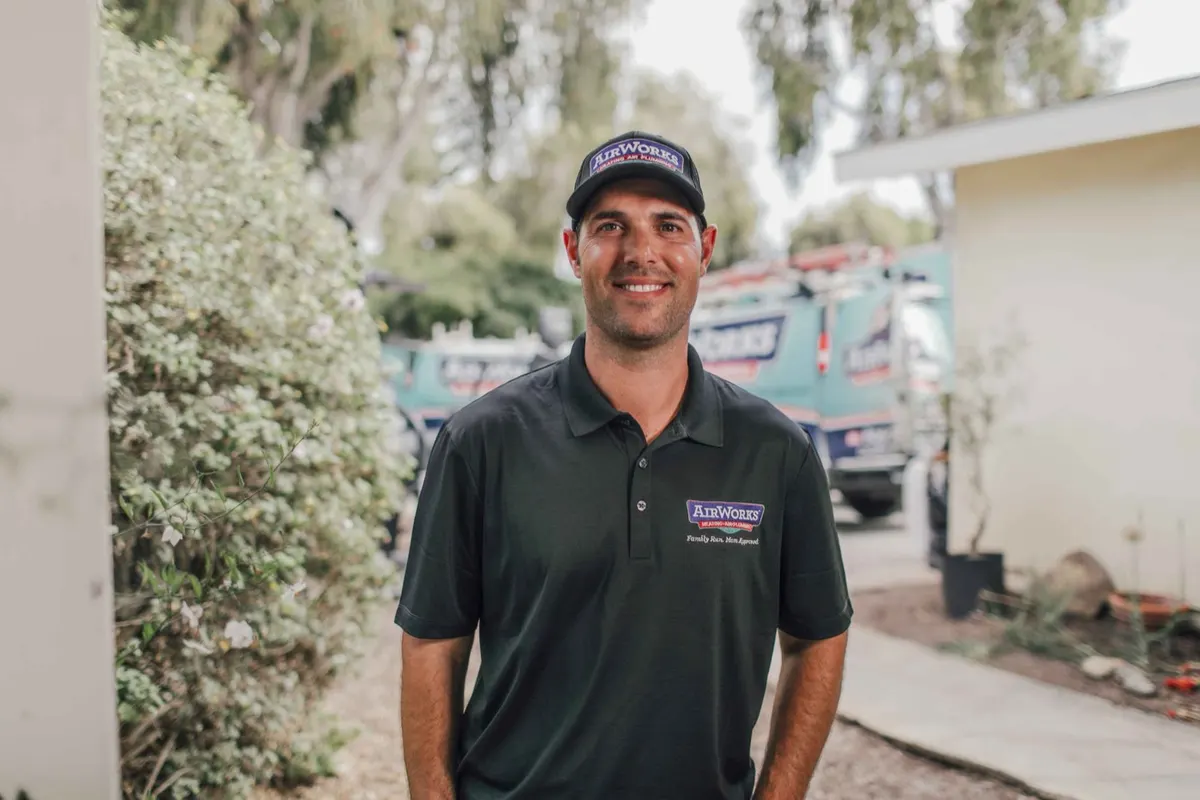
Kevin Allen
Co-Founder & Service Lead
Co-founded AirWorks in 2010 and has worked in Ventura County HVAC since 2002. Leads the service and installation crews — and the fix-what's-actually-broken ethic the company was built on.
Need Help?
Contact us today to discuss your needs. Our team is ready to help.
Related Articles
Options Comparisons for Homeowners: Heat Pump vs. Gas Furnace
Read Options Comparisons for Homeowners: Heat Pump vs. Gas FurnaceWhy Is Your Air Conditioner Hissing When Off? Causes and Diagnostics
Read Why Is Your Air Conditioner Hissing When Off? Causes and DiagnosticsHeat Pump vs. Gas Furnace: Technical Options Comparisons for Homeowners
Read Heat Pump vs. Gas Furnace: Technical Options Comparisons for HomeownersReady to Get Started?
Whether you need a repair, maintenance, or a new installation, our expert team is here to help.