DIY AC Troubleshooting: Fix It Before You Call It
Kevin Allen
Co-Founder & Service Lead

Master AC troubleshooting tips before calling a professional: check thermostat, filters, airflow & more for quick DIY fixes!
Is Your AC Acting Up? Try These DIY AC Troubleshooting Tips Before Calling a Professional
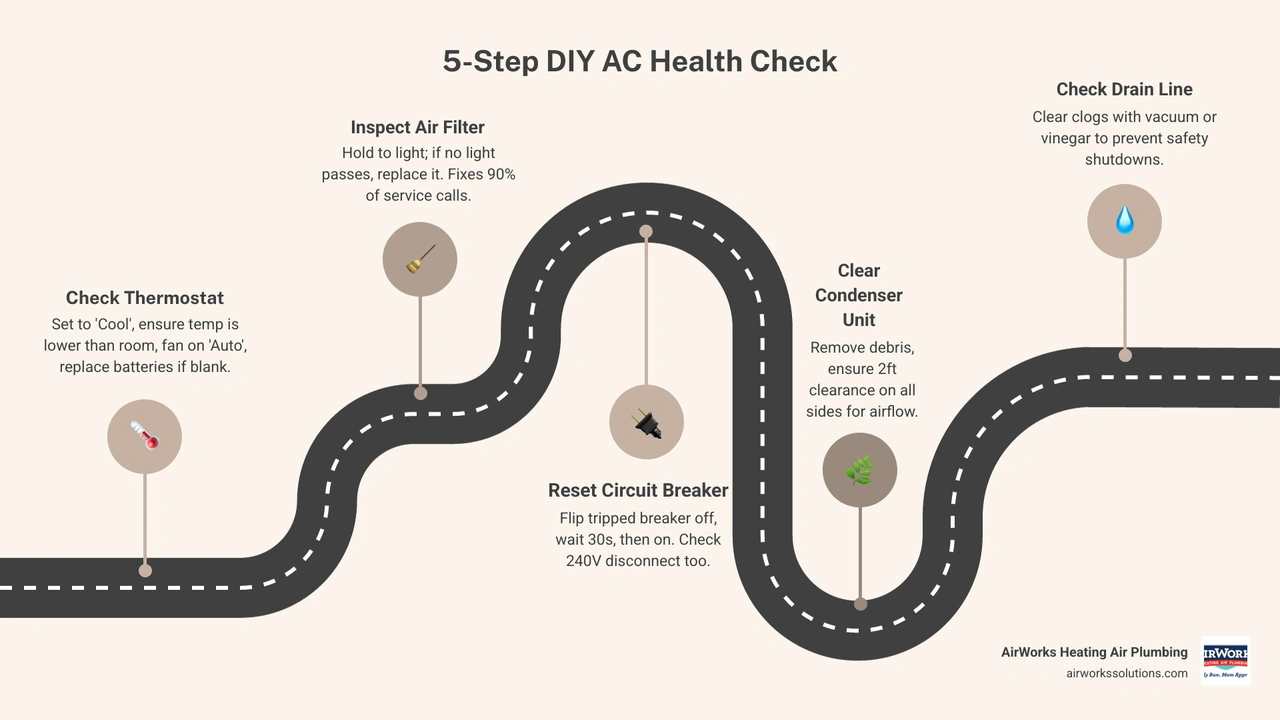
If you're looking for AC troubleshooting tips before calling a professional, here's a quick checklist to start with:
- Check your thermostat - Make sure it's set to "Cool," the temperature is lower than the current room temp, and the fan is on "Auto" not "On." Replace batteries if the screen is blank.
- Inspect your air filter - Pull it out and hold it up to a light. If you can't see light through it, replace it. This single issue accounts for 9 out of 10 AC service calls.
- Reset your circuit breaker - Find your electrical panel, look for a tripped breaker, flip it fully to "Off," wait 30 seconds, then flip it back "On."
- Clear the outdoor condenser unit - Remove leaves, dirt, or debris. Make sure there's at least 2 feet of clearance on all sides.
- Check the condensate drain line - Look for standing water near your indoor unit. A clogged drain line can trigger a safety shutoff and kill power to the whole system.
If none of those fix the problem, it's time to call in a pro.
Picture this: it's a sweltering summer afternoon in Ventura County, you walk through the door expecting relief, and your AC is blowing warm air — or worse, nothing at all. It's one of the most frustrating moments a homeowner can face, and the instinct is usually to grab the phone and schedule a service call right away. But here's the thing — a surprising number of AC issues have simple causes that you can identify and fix yourself in under an hour, without any special tools or technical know-how. Whether your system won't turn on, isn't cooling properly, or is making a strange noise, working through a few basic checks first can save you time, money, and unnecessary stress.
I’m Kevin Allen, co-founder of AirWorks and the qualifying individual on our C-20 and C-36 licence. Let’s walk through what to check, what it means, and when it really is time to pick up the phone.
Essential AC Troubleshooting Tips Before Calling a Professional
When your air conditioner stops performing, it can feel like a total system failure. However, we often find that the "broken" unit is simply reacting to a minor environmental or electrical change. Before you assume you need a massive repair, it helps to play detective.
In regions like Sacramento and Thousand Oaks, our systems work incredibly hard during the summer months. This heavy load can lead to most common AC repairs and what causes them, many of which start as simple maintenance oversights.

Check Your Thermostat: AC Troubleshooting Tips Before Calling a Professional
It sounds almost too simple, but the thermostat is the brain of your HVAC system, and sometimes it just needs a little guidance.
- Mode Settings: Ensure the system is actually set to "Cool." It is remarkably common for a family member to accidentally switch the system to "Heat" or "Off" while cleaning or adjusting settings.
- Temperature Calibration: Set the thermostat at least 3 to 5 degrees below the current room temperature. If the thermostat thinks the room is already cool enough, it won't trigger the cooling cycle.
- Battery Replacement: If your thermostat display is blank or flickering, the batteries are likely dead. Many homeowners don't realize that even hard-wired systems often have battery backups that need replacing every year.
- Fan Settings (Auto vs. On): This is a big one. If your AC is blowing lukewarm air, check if the fan is set to "On." In the "On" position, the fan runs 24/7, even when the outdoor compressor isn't cooling the air. Switch it to "Auto" so the fan only blows when the air is actually being chilled.
Inspect Your Air Filter: AC Troubleshooting Tips Before Calling a Professional
If you take only one thing away from this guide, let it be this: A dirty air filter is the single most common cause of AC problems. Statistics show that 9 out of 10 central air units that aren't working well simply have a dirty filter.
When a filter is clogged with dust, pet hair, and Sacramento pollen, it restricts airflow. This forces your blower motor to work overtime, which can lead to overheating and a total system shutdown. To check yours, perform the "light test." Slide the filter out and hold it up to a nearby light source. If you cannot see light passing through the fibers, it’s time for a change. For the best AC maintenance in Thousand Oaks, we recommend replacing standard 1-inch filters every 1 to 3 months.
Verify Electrical Power and Circuit Breakers
Your AC system actually uses two different electrical circuits: one for the indoor air handler and a high-voltage 240V circuit for the outdoor condenser. If one trips, the other might stay on, leading to a situation where the fan blows but the air never gets cold.
- Check the Main Panel: Look for a breaker that is in the "middle" position or flipped the opposite way of the others.
- The Proper Reset: To reset a breaker, you must flip it all the way to "Off" first, wait about 30 seconds, and then flip it back to "On."
- The Outdoor Disconnect: Near your outdoor unit, there is a small metal box. Inside is a disconnect switch or a pull-out fuse block. Ensure it hasn't been bumped or disconnected during yard work.
- Safety Switches: Many modern units have a "float switch" near the indoor drain pan. If the drain line clogs and water backs up, this switch will kill power to the unit to prevent a flood in your home.
Addressing Airflow and Cooling Performance Issues
If your system is running but your home still feels like a sauna, you’re likely dealing with an airflow or heat exchange problem. This doesn't always mean you're low on refrigerant. In fact, you should ask yourself: Is my AC broken or just low on refrigerant? before jumping to conclusions.
Clearing Debris from the Outdoor Condenser
The outdoor unit (the condenser) is responsible for releasing the heat collected from inside your home. If it’s buried under leaves, grass clippings, or overgrown bushes, it can’t "breathe."
- Clearance: Maintain at least two feet of clear space around the sides of the unit and five feet of clearance above it.
- Cleaning: You can gently hose down the condenser coils with a garden hose to remove dust and dirt. Never use a pressure washer, as the high pressure will flatten the delicate aluminum fins and ruin the unit's efficiency.
- Vegetation: Trim back any vines or shrubs that have crept toward the unit during the spring growing season.
Identifying and Thawing a Frozen Evaporator Coil
It sounds counterintuitive, but your AC can actually freeze up in the middle of a 100-degree May afternoon. This usually happens because restricted airflow (from that dirty filter we mentioned!) causes the temperature of the internal coils to drop below freezing, turning condensation into ice.
Signs of a frozen coil:
- Visible ice on the copper refrigerant lines.
- Cold air stops blowing, but the fan is still running.
- Water pooling around the indoor unit as the ice melts.
What to do: Turn the system to "Off" at the thermostat and switch the fan setting to "On." This blows warm air across the ice to melt it safely. Do not try to scrape the ice off, as you could puncture the coils. It may take 2 to 4 hours to thaw completely. Once thawed, replace the filter and try the system again.
Unclogging the Condensate Drain Line
As your AC cools the air, it also removes humidity. That moisture collects in a drain pan and flows out through a PVC pipe. Over time, algae and mold can grow in this pipe, creating a "sludge" that blocks the flow.
If you see standing water in the drain pan or the system has shut off due to the float switch, you can often clear the clog yourself. Use a wet/dry vacuum on the end of the drain line (usually located outside near the condenser) to suck out the blockage. To prevent future clogs, pour a cup of white vinegar down the drain line access point near your indoor unit once a month during the summer.
Identifying Unusual Noises and Warning Signs
Your AC should produce a steady whirring of the fan and a rhythmic hum from the compressor. Anything else is a cry for help.
| Sound | Potential Meaning | DIY Fix? |
|---|---|---|
| Rattling/Banging | Loose panel or debris in the fan | Tighten screws; remove leaves |
| Hissing | Refrigerant leak | No - Call a Pro |
| Squealing | Failing fan belt or motor bearing | No - Call a Pro |
| Grinding | Compressor or motor failure | No - Call a Pro |
| Buzzing | Electrical issue or failing capacitor | No - Call a Pro |
While we want to empower you with AC troubleshooting tips before calling a professional, there is a line where DIY becomes dangerous or counterproductive.
If you notice a pungent, "burning" smell, turn the power off immediately—this indicates failing electrical insulation. If you hear hissing or see ice returning immediately after you changed the filter, you likely have a refrigerant leak. Handling refrigerant requires EPA certification and specialized equipment; it is never a DIY task. Furthermore, attempting to take apart the compressor or motor can void your manufacturer's warranty.
When the simple fixes don't work, it’s time to look for professional AC repair in Sacramento. A trained technician can perform a deep diagnostic to find the root cause, whether it's a failing capacitor or a complex control board issue.
Frequently Asked Questions about AC Troubleshooting
Why is my AC running but blowing warm air?
The most common reasons are a thermostat set to "On" instead of "Auto," a dirty air filter, or a tripped breaker for the outdoor unit. If the indoor fan is running but the outdoor unit isn't, the air won't be cooled. Check your outdoor disconnect and the condenser coils for dirt.
How often should I realistically change my AC filter?
In Ventura County, we recommend every 30 to 90 days. However, if you have pets that shed or if it’s a particularly high-pollen season in May 2026, you should check it monthly. If you can't see light through it, it's done.
What causes my AC to keep tripping the circuit breaker?
This is usually a sign that a component is drawing too much power. It could be an overheating compressor, a failing motor, or a grounded circuit. Do not keep resetting the breaker. If it trips a second time, call a professional to avoid causing a fire or permanent damage to your system.
Conclusion
Taking ten minutes to run through these AC troubleshooting tips before calling a professional can save you from an unnecessary service fee and get your home back to a comfortable temperature much faster. Most of the time, a simple filter change or a flipped breaker is all it takes to restore your cool.
However, your air conditioner is a complex piece of machinery that requires professional care to reach its full 10- to 15-year lifespan. Regular preventative maintenance is the best way to avoid these mid-summer emergencies. At AirWorks Heating Air Plumbing, we’ve spent over a decade providing reliable, customer-focused service across and Ventura County.
Don't let a minor issue turn into a major breakdown. Schedule your professional AC inspection today and ensure your system is ready to handle the heat!

About the Author
Kevin Allen
Co-Founder & Service Lead
Co-founded AirWorks in 2010 and has worked in Ventura County HVAC since 2002. Leads the service and installation crews — and the fix-what's-actually-broken ethic the company was built on.
Need Help?
Contact us today to discuss your needs. Our team is ready to help.
Related Articles
Options Comparisons for Homeowners: Heat Pump vs. Gas Furnace
Read Options Comparisons for Homeowners: Heat Pump vs. Gas FurnaceWhy Is Your Air Conditioner Hissing When Off? Causes and Diagnostics
Read Why Is Your Air Conditioner Hissing When Off? Causes and DiagnosticsHeat Pump vs. Gas Furnace: Technical Options Comparisons for Homeowners
Read Heat Pump vs. Gas Furnace: Technical Options Comparisons for HomeownersReady to Get Started?
Whether you need a repair, maintenance, or a new installation, our expert team is here to help.