The 2026 Healthy Home Audit
Kevin Allen
Co-Founder & Service Lead

Discover the Whole-Home Health Audit: Boost IAQ, energy efficiency & wellness in 2026. Get pro tips, DIY steps & schedule now!
Why Every Ventura County Homeowner Needs "The 2026 Healthy Home Audit"
A Whole-Home Health Audit is a comprehensive assessment of your home as a complete system — evaluating energy efficiency, indoor air quality (IAQ), moisture levels, combustion safety, and plumbing health all in one visit. As part of our "2026 Healthy Home Audit" campaign, we focus on the reality that California homes are getting tighter, which often causes indoor air to become "stale" and trapped with pollutants.
Here's what a Whole-Home Health Audit typically covers:
- Energy efficiency — insulation, air sealing, duct leakage, and HVAC performance
- Indoor air quality — VOCs, CO2 sensor compliance, allergens, and ventilation adequacy
- Moisture and mold risk — hidden leaks, humidity, and crawl space conditions
- Combustion safety — carbon monoxide, gas appliance venting, and draft testing
- Plumbing health — water heater efficiency, pipe integrity, and leak detection
- Mechanical ventilation compliance — demand-controlled ventilation and 2026 standards
Your home should be a safe haven — not a source of high bills, stale air, or hidden health risks. With 2026 regulations mandating better mechanical ventilation and CO2 monitoring, the stakes have never been higher. A single, thorough Whole-Home Health Audit gives you a clear, prioritized roadmap — so you stop guessing and start fixing what actually matters.
I’m Kevin Allen, co-founder of AirWorks and the qualifying individual on our California licence. In this guide, we’ll walk you through exactly what the process involves, what to expect, and how to use the results to make smarter decisions for your home.

Understanding the Benefits of a Whole-Home Health Audit
When we talk about building science in 2026, we are looking at the house as an integrated ecosystem. In the past, you might have called a plumber for a leak or an HVAC technician because a room was too cold. A Whole-Home Health Audit breaks down those silos. By evaluating the "building envelope"—the shell that separates your conditioned air from the outside—we can identify why your energy bills are spiking and why your indoor air might feel "stale."
One of the primary benefits is the direct link between efficiency and wellness. For instance, air leakage can be responsible for up to one-third of your heating costs. But those same gaps that let heat escape also allow dust, pollen, and outdoor pollutants to enter. By performing an insulation evaluation in Citrus Heights, CA, we don't just look at R-values; we look at how that insulation acts as a filter for your home.
| Feature | Standard Energy Audit | Whole-Home Health Audit |
|---|---|---|
| Focus | Utility bill reduction | Occupant health & system performance |
| Air Leakage | Visual inspection | Blower door diagnostic testing |
| Air Quality | Not typically included | VOC, CO2 sensor compliance, and particulate testing |
| Safety | Basic smoke alarm check | Combustion safety & gas leak detection |
| Plumbing | Visual water heater check | Pipe integrity & leak detection |
| Outcome | List of energy fixes | Prioritized health & efficiency roadmap |

Advanced IAQ Testing within a Whole-Home Health Audit
Indoor air quality (IAQ) has become a centerpiece of home wellness, especially with the 2026 regulations mandating better mechanical ventilation. Modern California homes are built to be "tight" to save energy, but without proper ventilation, pollutants like Volatile Organic Compounds (VOCs) from furniture and cleaning products, as well as CO2 from breathing, can reach unhealthy levels.
During our audit, we use advanced sensors to monitor these levels and ensure CO2 sensor compliance. We also evaluate the need for demand-controlled ventilation to ensure your home breathes only when necessary, saving energy while maintaining freshness. Keeping your system in peak condition is vital; following ultimate HVAC maintenance tips for homeowners can help, but the audit provides the data needed to see if you need more advanced filtration or smart ventilation strategies.
Key Components of a Professional Assessment
To get a true picture of your home’s health, we use specialized diagnostic tools that go far beyond what the naked eye can see.
- Blower Door Test: We install a powerful fan in the frame of an exterior door to depressurize your house. This makes air leaks easy to find. It’s often eye-opening for homeowners to learn that the cumulative effect of small leaks can equal the size of a window being left open year-round!
- Infrared Thermography: Using infrared cameras, we can see "thermal bridges" or gaps in insulation behind your walls. This is essential for an energy efficiency assessment in Malibu, CA, where coastal temperatures can fluctuate.
- Duct Leakage Testing: Poorly sealed ducts can lose up to 50% of the air they carry before it ever reaches your living space. We measure this loss to ensure your HVAC system isn't working twice as hard for half the comfort.
- Combustion Safety: We test gas-burning appliances to ensure they aren't back-drafting carbon monoxide into your home. This is a non-negotiable safety step.
- Insulation Check: We don't just check if you have insulation; we check its depth and condition. An insulation inspection in Carmichael, CA often reveals settled or missing material that significantly impacts comfort.
"I'm concerned about the air quality in my house. Can anyone recommend advanced air purification services in Malibu?"
This is a question we hear frequently. Advanced air purification is no longer a luxury; for many, it's a necessity for health. Within the framework of a Whole-Home Health Audit, we evaluate if your home would benefit from HEPA filtration, which captures 99.97% of particles, or UV light systems that neutralize biological contaminants like mold and bacteria.
The Tech Edge: We also promote the use of smart thermostats that integrate with SCE (Southern California Edison) time-of-use rates. This allows your home to automatically lower bills by shifting energy-intensive cooling or ventilation tasks to off-peak hours. Humidity control is another factor. In areas like Lake Sherwood or Camarillo, maintaining the right balance of moisture prevents dust mites and mold from thriving. If you've recently had an energy efficiency assessment in Lake Sherwood, CA or an energy efficiency assessment in Camarillo, CA, you know that a tight home requires a smart ventilation strategy to keep the air fresh without wasting energy.
DIY Steps to Assess Your Home’s Health
While a professional audit is necessary for technical diagnostics, you can start the process yourself with a few simple steps.
- The Incense Stick Test: On a windy day, light a stick of incense and hold it near windows, outlets, and baseboards. If the smoke moves horizontally, you’ve found an air leak.
- Utility Bill Analysis: Look at your bills from the last 12 months. Identify your "baseline"—the months with the lowest usage. If your summer or winter peaks are more than double your baseline, your home is likely losing significant energy.
- Visual Filter Check: Hold your HVAC filter up to a light. If you can't see light through it, it’s clogged and straining your system.
- Insulation Measurement: Head into the attic with a ruler. For modern standards, you generally want 10 to 14 inches of insulation. If you see wooden floor joists peeking through, you definitely need an insulation evaluation in Agoura Hills, CA.
DIY Audit Toolkit:
- Flashlight (for dark corners of the attic/crawlspace)
- Ruler (to measure insulation depth)
- Incense sticks or a smoke pen (to find drafts)
- Your last 12 months of utility bills
- A screwdriver (to check for gaps around exterior outlets)
Frequently Asked Questions about Home Health Assessments
What is the difference between a health audit and an energy audit?
A standard energy audit focuses primarily on how much energy your home consumes and where it is wasted. A Whole-Home Health Audit expands that scope to include your physical well-being. It tests for indoor pollutants, moisture that causes mold, and the safety of your gas appliances, ensuring the home is not just cheap to run, but safe to live in.
How long does a professional whole-home assessment take?
A thorough assessment typically takes between 2 to 4 hours, depending on the size of your home and the complexity of your systems. We take the time to interview you about any comfort issues or health symptoms (like frequent allergies) you've noticed.
What preparations should I make before the auditor arrives?
To get the most accurate results, please ensure all exterior windows and doors are closed. Clear a path to your HVAC system, water heater, and attic access point. If you have a fireplace, ensure it hasn't been used for at least 24 hours so the ashes are cold before we perform a blower door test.
Conclusion
At AirWorks Heating, Air & Plumbing, we’ve been serving the greater Ventura County areas since 2010. We know that "The 2026 Healthy Home Audit" is the essential first step for any homeowner looking toward electrification or renewable energy. You wouldn't put a brand-new engine in a car with a flat tire; similarly, you shouldn't install a new heat pump or solar panels before ensuring your home’s "envelope" is sealed and healthy.
By taking a whole-house approach, we help you prioritize fixes that offer the best return on investment for your comfort and your wallet. Whether you are in Thousand Oaks, Simi Valley, or right here in Sacramento, our goal is to provide honest, reliable solutions that make your home the safe haven it was meant to be.
Schedule your IAQ assessment today and take the first step toward a healthier, more comfortable 2026.
Service Areas
Proudly Serving Your HVAC & Plumbing Needs Throughout Ventura County
From Santa Barbara to San Fernando Valley and Everything in Between!

Air Conditioning
AC Repair & Installation in Ventura County
Don’t let the California heat compromise your comfort. Our licensed technicians specialize in high-efficiency AC installation, 24/7 emergency air conditioning repair, and preventative tune-ups designed to lower your energy bills.
Explore Our Air Conditioning

Heating
Heating & Furnace Services
Stay cozy all winter with reliable heating solutions. From furnace repairs to heat pump installations, we ensure your home stays warm and energy-efficient. We service all major brands with same-day emergency support available.
Explore Our Heating

Plumbing
Full-Service Residential Plumbing
From leaky faucets to water heater replacements, our expert plumbers handle it all. We offer honest, upfront pricing on drain cleaning, leak detection, and plumbing maintenance to keep your home’s water systems running smoothly.
Schedule My Insulation

Insulation
Attic Insulation & Home Performance
Maximize your HVAC efficiency with professional attic insulation. Our team helps you reduce heat transfer, improve indoor air quality, and save up to 15% on heating and cooling costs with modern, "Mom-Approved" insulation materials.
Schedule My Insulation
Testimonials
Hear What Our Satisfied Clients Have To Say
I have never had such an amazing experience with plumbing, most honest, reliable, friendly, knowledgeable and professional people. I had a leak in my house and their diagnostics was to the point and as they promised they show up next day with top of the line parts that needed to get change and on time. The membership they offered is totally worth it. Very competitive price.
Art was amazing! He called prior to arrival, got to work right away, and was super helpful and informative. He was done before I even knew what happened, showed me how everything works, and was on his way to his next lucky customer. A true professional and great human being. Highly recommend!
Sam was wonderful! He addressed the issue and fixed it. He was really kind, communicative, and tidy. I appreciated AirWorks working with our tight schedule when we were leaving out of town the next day, and had a leak! Thanks guys!
Julian Duncan, plumber, was great! He was knowledgeable, professional, and friendly. He installed Moen leak detection device in a timely manner, helped me set up the beginning stages of the app., and answered my questions about the set up when I didn’t know what to do. I would recommend him. Thank you Julian! I really appreciated your help and expertise. A real Pro!
Outstanding service by Nick and Sam. They are professional, courteous and extremely knowledgeable. They took great care in going through my HVAC system, keeping me informed of everything they were doing every step of the way. I am delighted with the service AirWorks provides. Do not hesitate in calling them for any of your HVAC needs.
Nick was fantastic. He arrived on time, diagnosed the issue quickly, and will have the repair of the AC running smoothly in no time. He was professional, courteous, and left the work area clean. Highly recommend!
Nick text ahead of time to let me know his arrival and was here right on time. He was knowledgeable about the equipment and made valuable recommendations. We were able to enroll in the family plan so that we can continue to receive such valuable service from a wonderful company.
Nick was friendly, on time, and diagnosed the issue quickly! He spent time answering all my questions and I left with working air conditioning! Thank you again!
Mike arrived on time and was professional and courteous. He kept us advised while he performed his work and wrapped up with a thorough explanation of his findings. An excellent experience and would highly recommend Air Works.
Excellent company! The staff is highly professional and quick to respond to client needs. From our very first interaction, I had a strong sense of honesty and trustworthiness. As someone in the real estate industry, it's rare to find vendors who operate with this level of integrity. I highly recommend them.
About the Author
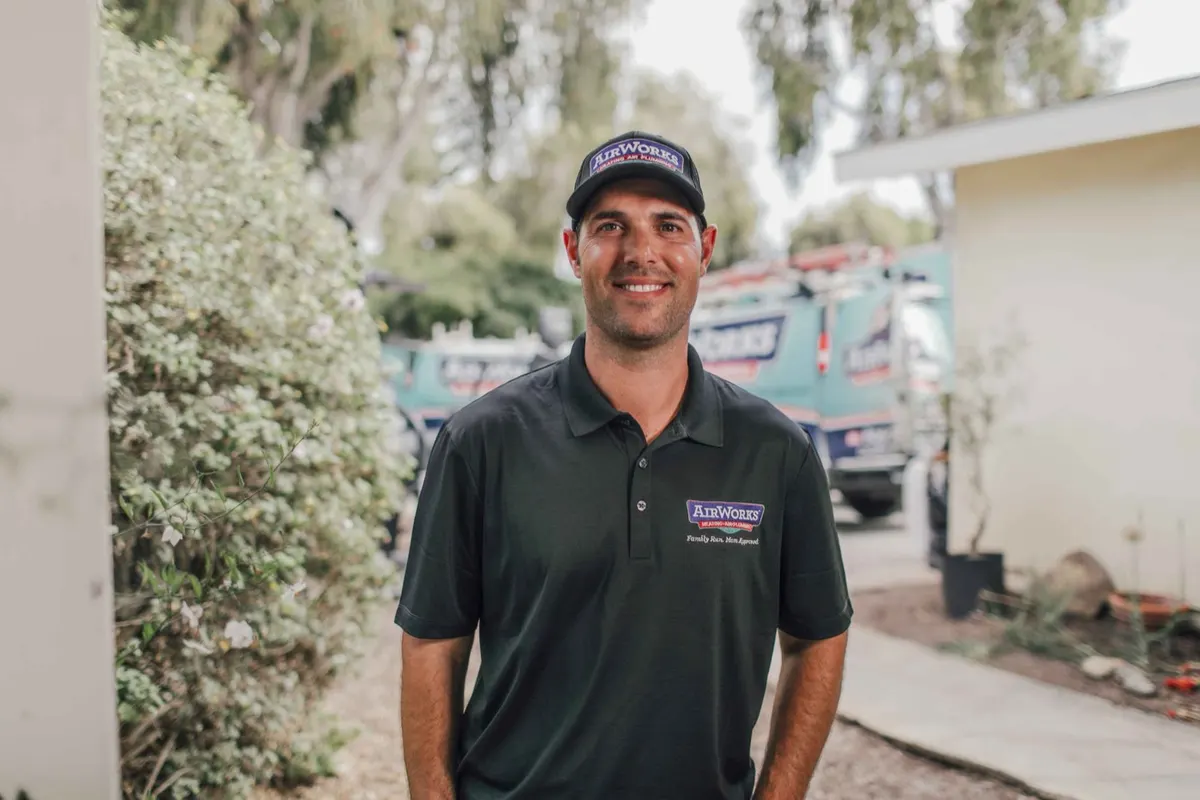
Kevin Allen
Co-Founder & Service Lead
Co-founded AirWorks in 2010 and has worked in Ventura County HVAC since 2002. Leads the service and installation crews — and the fix-what's-actually-broken ethic the company was built on.
Need Help?
Contact us today to discuss your needs. Our team is ready to help.
Related Articles
Options Comparisons for Homeowners: Heat Pump vs. Gas Furnace
Read Options Comparisons for Homeowners: Heat Pump vs. Gas FurnaceWhy Is Your Air Conditioner Hissing When Off? Causes and Diagnostics
Read Why Is Your Air Conditioner Hissing When Off? Causes and DiagnosticsHeat Pump vs. Gas Furnace: Technical Options Comparisons for Homeowners
Read Heat Pump vs. Gas Furnace: Technical Options Comparisons for HomeownersReady to Get Started?
Whether you need a repair, maintenance, or a new installation, our expert team is here to help.