How a Quality Installation Pays for Itself Over Time
Kevin Allen
Co-Founder & Service Lead

Why How a Quality Installation Pays for Itself Over Time Is the Smartest Question You Can Ask
How a quality installation pays for itself over time is something every Ventura County homeowner deserves a straight answer to — and here it is:
A quality installation pays for itself through:
- Lower monthly energy bills — Properly sized and commissioned systems use 10–30% less energy than poorly installed ones
- Fewer repairs — Professional installation reduces component stress, meaning fewer breakdowns and emergency service calls
- Longer system life — Professionally installed HVAC systems routinely last 15–20 years, compared to just 10–12 years for substandard installations
- Warranty protection — Most manufacturers require certified professional installation for warranties to remain valid
- Higher home value — Energy-efficient systems can increase home value by 5–7% on average
For most homeowners, the return on the quality premium arrives within 3 to 7 years — and the system then spends the rest of its life saving you money.
Most homeowners only think about the price tag on installation day. But the real number that matters is what you spend — or save — over the next 15 to 20 years. A system that costs less upfront but runs inefficiently, breaks down often, or fails at year 10 instead of year 18 can end up costing thousands more than a quality installation ever would.
Think of it this way: the upfront cost is just the beginning of the story. Improperly installed HVAC systems can increase energy use by as much as 30%, according to industry data. That kind of inefficiency quietly drains your wallet every single month — long after the install crew has gone home.
The difference between a quality installation and a rushed one often comes down to details most homeowners never see: precise refrigerant charging, proper airflow balancing, sealed ductwork, and accurate system sizing. Get those right, and you have a system that earns its keep. Get them wrong, and you are paying for that mistake for years.
I’m Kevin Allen, co-founder of AirWorks and the qualifying individual on our C-20 and C-36 licence. In the sections ahead, we’ll walk you through exactly what drives that return and how to make sure your next installation works for you, not against you.

How do I calculate my solar payback period and ROI in 2026?
While we often focus on HVAC and plumbing, many homeowners in our service area, from Folsom to Sloughhouse, are looking at the total energy picture of their home. A major part of that picture in May 2026 is solar energy. Understanding your Return on Investment (ROI) and payback period is essential to seeing the full financial benefit.
The solar payback period is the amount of time it takes for the system to pay for itself through electricity bill savings. To calculate this, you start with the total system cost and subtract any upfront incentives, such as the federal tax credit (which remains a significant factor in 2026). This gives you your net cost.
Next, you estimate your annual savings. This is the amount of money you would have spent on utility bills that you are now saving because of your panels. Divide your net cost by your annual savings, and you have your payback period in years. For example, if your net cost is $15,000 and you save $1,500 a year, your payback period is 10 years.
ROI (Return on Investment), on the other hand, looks at the total profit you’ll make over the system's 25-to-30-year lifespan. In the United States, the average payback time is about 10 years, meaning you could enjoy 15 to 20 years of essentially free electricity.
To truly maximize these returns, we recommend starting with an Energy Efficiency Assessment. By making sure your home isn't leaking air before you install solar, you can often get away with a smaller, more affordable system that pays for itself even faster.
| Metric | National Average | California (High Rate Area) |
|---|---|---|
| Payback Period | 9–12 Years | 6–9 Years |
| Annual ROI | ~10% | 15–20% |
| 25-Year Savings | $37,000–$154,000 | $50,000–$160,000+ |
How a Quality Installation Pays for Itself Over Time

When we talk about how a quality installation pays for itself over time, we are looking at the "Lifecycle Cost." This is the total cost of owning the system, including the purchase, energy bills, and repairs. A quality installation focuses on the long game.
A professionally installed high-efficiency AC can offset its own incremental cost in just a few years. How? Through lower utility bills and avoided emergency repairs. While a budget installation might save you money on day one, the hidden costs start piling up immediately. From poor refrigerant levels that force the compressor to work harder to leaky ducts that dump conditioned air into your attic, those "savings" evaporate quickly.
Our AC Installation Guide highlights that a quality setup ensures the system reaches its full rated efficiency (SEER2). Without professional commissioning, even the most expensive unit on the market will underperform.
Why how a quality installation pays for itself over time starts with proper sizing
In cities like Folsom and Sacramento, where summer temperatures can stay in the triple digits for days, sizing is everything. We never use "rules of thumb" like "one ton per 500 square feet." Instead, we perform a Manual J load calculation.
This calculation takes into account your home’s square footage, insulation levels, window orientation, and even the number of people living in the house. If a system is too big, it will "short cycle," turning on and off constantly. This doesn't just waste energy; it fails to remove humidity, leaving your home feeling clammy. If it's too small, it will run 24/7 and still never reach the target temperature.
A quality Heat Pump Installation also requires precise airflow balancing. We make sure that every room gets the exact amount of air it needs so you don't have hot or cold spots. This precision is a cornerstone of how a quality installation pays for itself over time.
Seeing how a quality installation pays for itself over time through reduced repairs
One of the most frustrating hidden costs of a poor installation is the "infant mortality" of components. When a system is installed incorrectly — perhaps with loose electrical connections or restricted airflow — the internal parts are under constant stress. This leads to premature failure of expensive components like the blower motor or the compressor.
In Somis and across Ventura County, we’ve seen budget installations struggle to reach their tenth birthday. In contrast, a professionally commissioned system with regular HVAC Maintenance can easily last 15 to 20 years.
Furthermore, most manufacturer warranties are conditional. If your system fails and the manufacturer discovers it wasn't installed according to their strict specifications, they may deny your warranty claim. A quality installation protects your investment by ensuring that if a part does fail, the manufacturer covers it.
The financial case for how a quality installation pays for itself over time becomes even stronger when you factor in modern incentives. As of May 2026, homeowners in the Sacramento and Ventura areas have access to several programs that lower the net cost of high-efficiency upgrades.
- Federal Tax Credits: Under the Inflation Reduction Act, homeowners can often claim significant tax credits for qualifying high-efficiency heat pumps, central AC units, and water heaters.
- Utility Rebates: Local utilities in Sacramento and Folsom frequently offer rebates for switching to high-efficiency electric systems or for improving your home's envelope.
- Net Metering: For those combining HVAC upgrades with solar, California's net metering policies (even under newer iterations) allow you to earn credits for the excess energy your system produces.
- Efficiency Programs: Programs like Whole Home Air Sealing can often be bundled with HVAC upgrades to maximize total home performance and qualify for higher-tier incentives.
By taking advantage of these, you reduce the "payback period" of your quality installation, moving the break-even point even closer to the installation date.
Frequently Asked Questions about Installation ROI
What is the average payback period for a high-efficiency HVAC system?
Most homeowners see the "quality premium" — the extra cost of a high-efficiency system and professional installation — pay for itself within 3 to 7 years. Given that these systems last 15 to 20 years, you could be looking at over a decade of pure savings on your utility bills.
How does professional installation affect my manufacturer warranty?
Manufacturer warranties are almost always tied to professional installation. Brands like Lennox, Carrier, and Trane require the system to be installed by a licensed contractor and often require proof of professional commissioning (like refrigerant charge levels and airflow tests) to honor a major part replacement.
Absolutely. A new, high-efficiency HVAC system can increase a home's value by 5% to 7%. In competitive markets like Sacramento, it acts as a major selling point, signaling to buyers that the home has been well-maintained. We often provide an HVAC Inspection for Real Estate to help sellers document the quality and efficiency of their systems for prospective buyers.
Conclusion
At AirWorks Heating, Air & Plumbing, we believe that your home's comfort systems should be an investment, not just an expense. Since 2010, we have provided the greater Ventura County areas with honest, customer-focused solutions that prioritize long-term reliability over a quick fix.
When you choose a quality installation, you aren't just buying a box of metal and wires. You are buying:
- Predictable monthly costs through superior energy efficiency.
- Peace of mind knowing your warranty is valid and your repairs will be minimal.
- Enhanced comfort with a system sized perfectly for your unique home.
- Sustainability by reducing your home's total energy footprint.
Whether you are in Thousand Oaks, El Dorado Hills, or downtown Sacramento, we are here to ensure your home services are handled with the expertise they deserve.
Ready to start your journey toward a more efficient, cost-effective home? Request a professional AC installation consultation with our expert team today.
About the Author
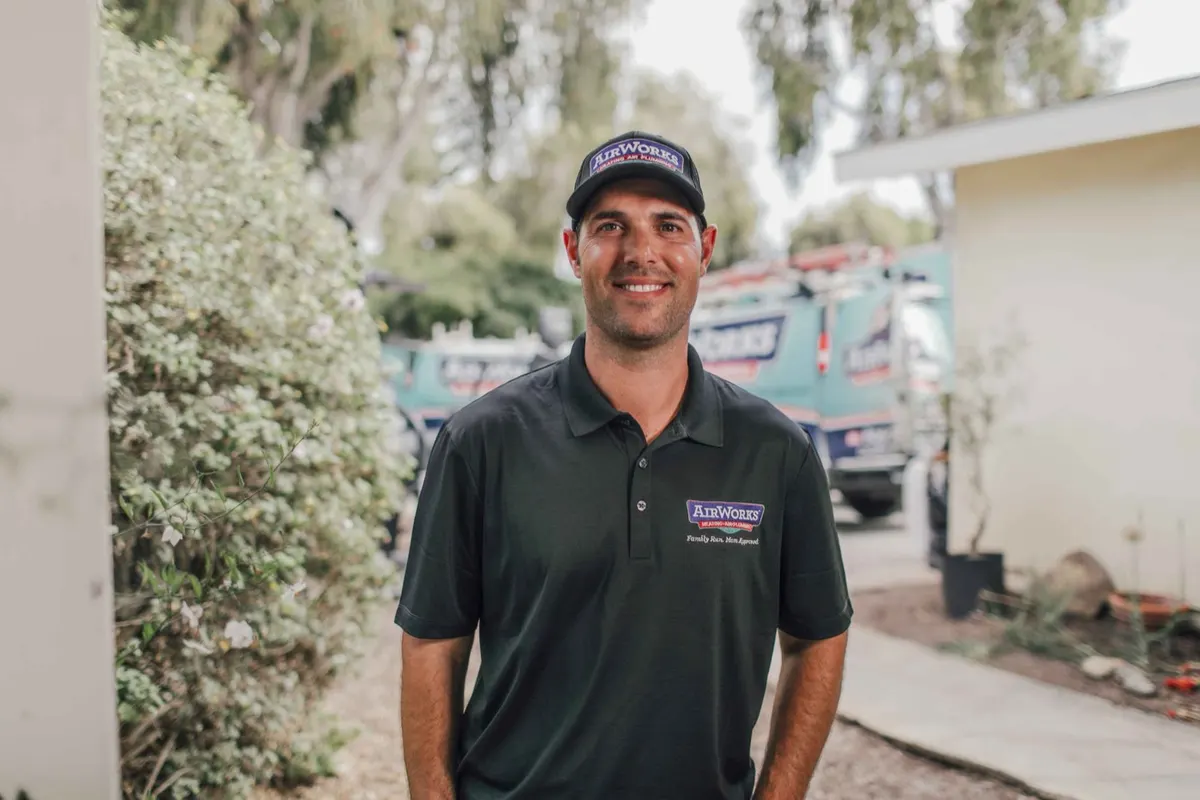
Kevin Allen
Co-Founder & Service Lead
Co-founded AirWorks in 2010 and has worked in Ventura County HVAC since 2002. Leads the service and installation crews — and the fix-what's-actually-broken ethic the company was built on.
Need Help?
Contact us today to discuss your needs. Our team is ready to help.
Related Articles
Options Comparisons for Homeowners: Heat Pump vs. Gas Furnace
Read Options Comparisons for Homeowners: Heat Pump vs. Gas FurnaceWhy Is Your Air Conditioner Hissing When Off? Causes and Diagnostics
Read Why Is Your Air Conditioner Hissing When Off? Causes and DiagnosticsHeat Pump vs. Gas Furnace: Technical Options Comparisons for Homeowners
Read Heat Pump vs. Gas Furnace: Technical Options Comparisons for HomeownersReady to Get Started?
Whether you need a repair, maintenance, or a new installation, our expert team is here to help.